There’s a neighborhood west of Orlando, out past the town of Windermere, where the houses were built facing a golf course the way other houses face the street. For thirty years that was the deal out there: a gate at the road, big lots, and a long green nobody could ever build on running right through the middle of everything. Then one spring the course just… stopped. Mowers quiet, flags down, the grass going shaggy on 155 acres that every back porch looked out on.
And the question that came next is a strange one for Central Florida, a place that fills an empty acre faster than almost anywhere in the country. Who owns a golf course after the golf is gone, and is anybody allowed to put houses on it?
A neighborhood built around a hole in its own middle
The place is Butler Bay, and the lakeside stretch of it that people call the Windermere Club. It went in during the 1980s on old grove-and-pasture land west of the historic town, and it was laid out the way a lot of Florida was laid out in those years: a developer takes a big piece of ground, draws a golf course down the center, and sells the lots around the edges for the view. The course here ran to about 155 acres. And here’s the part that matters later, when the plat was recorded, the development rights to that course land were dedicated to Orange County. On paper, the open ground was supposed to stay open ground.
So the room wasn’t an accident or a leftover. It was the product. Nobody pays a premium for a half-acre lot behind a gate because of the half acre. They pay for everything they can see past it and never have to mow.
The town that was always about room
None of this was a new idea out here. It’s the whole reason Windermere exists in the first place. In 1887 an Englishman named John Dawe platted a little village on the narrow neck of land between two lakes and named it after Windermere, in the English Lake District, because the water reminded him of home. What he was really selling was space, lots on high ground between the lakes, in a part of Florida that was mostly pine, palmetto, and open range.

The people who came did what people did all over frontier Florida. They claimed their acres and built up a piece at a time, a house first, then a kitchen out back away from the heat, then a barn, then a grove once the land was clear. Nobody finished a Florida homestead in a season. You got your room and you added onto it as life asked you to, because the ground was sitting right there to add onto.
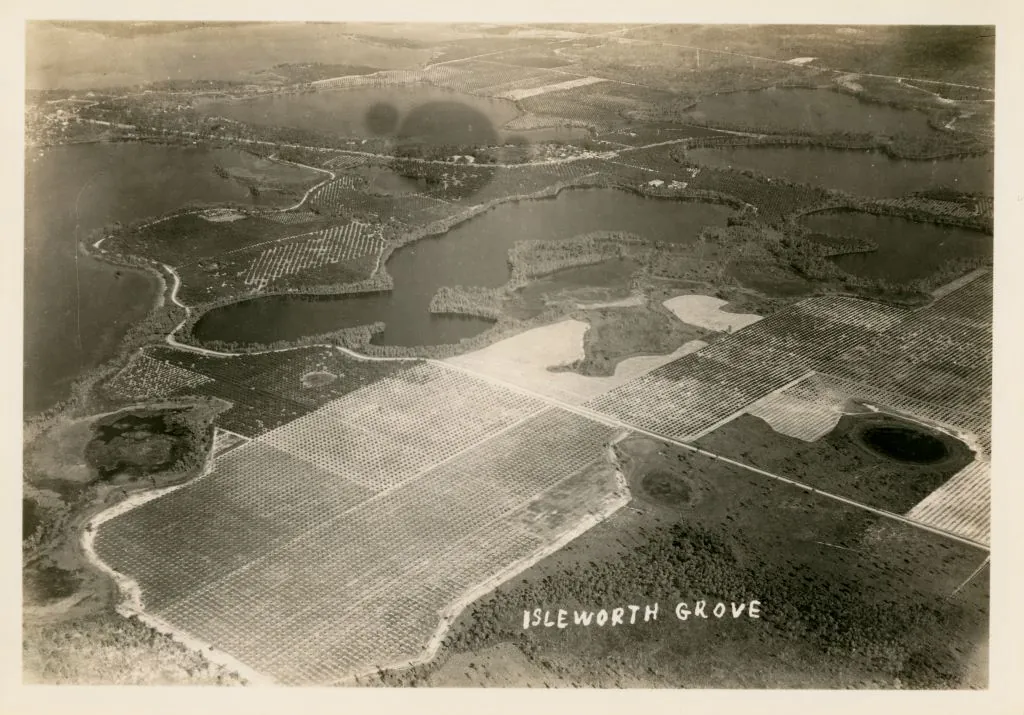
And for a long while the thing they added was oranges. By the 1920s the land around Windermere was groves, worked by crews who came through the rows on ladders, and the town had houses and stores and a rail platform to ship the fruit north.

A grove is a slow, patient use of land, you plant trees and wait most of a decade before they really pay. It only makes sense if you’ve got room to spare and time to let it work. That’s the bargain this whole corner of the county was built on: get more ground than you need right now, and let it earn its keep later.

You can see the habit written down. The old county maps don’t just show the lakes; they show the land cut into squares with the owners’ names printed right on their parcels, a whole county drawn as a record of people getting their piece and holding it.

When the freezes won, the room stayed
The groves didn’t last. Hard freezes came through Central Florida, one bad winter after another over the decades, and each one chipped at the trees. And once Orlando started growing west toward the lakes, grove land this close to a city was worth far more with houses on it than with oranges, lakefront grove land most of all. The fruit went. The thing that had made the fruit possible did not. The room stayed, and the clear water stayed, and that turned out to be the whole inheritance.
Which is where the golf course comes back in. By the 1980s the way you cashed in the room wasn’t a grove, it was a subdivision wrapped around an amenity. Butler Bay’s course opened in that decade, and for a generation it did exactly what a grove once did, it was the reason the land around it was worth something. Every lot borrowed its value from all that open green nobody could build on.
The day they had to vote on empty space
Then the course closed, in the spring of 2016. The owner pointed to falling membership and the cost of keeping the thing watered and mowed, which is a real problem all over golf-course Florida. And a closed course is a strange kind of asset: 155 acres of prime, gated, lakefront-adjacent ground sitting there growing weeds. Anybody looking at it with a developer’s eye sees the obvious move. Put houses on it.
That’s exactly what got proposed, a plan to carve roughly 95 new home lots out of part of the old course and leave the rest as ponds and green space. On its face it’s reasonable. The golf is gone; the land is valuable; fill some of it in.
But remember the fine print from the 1980s. Those development rights had been dedicated to the county. So it wasn’t the owner’s call alone, and it wasn’t the neighbors’ either. In the fall of 2016 the Orange County Commission took it up, and they voted, unanimously, not to hand those rights back. No 95 houses. The 155 acres would stay the 155 acres.
Sit with how odd that is. In a metro that paves whatever it can, a government looked at 155 buildable acres inside a gate and decided the best use of it was to stay open. The room won the vote. The thing Windermere had been protecting since 1887, mostly out of habit and taste, got protected one more time, this time on the record, by a show of hands.
What’s out there now
The lakes are still the reason, the way they always were. The Butler Chain, the string of connected lakes Windermere sits among, is still clear, still the thing people are really buying when they buy out here.

And the town itself still guards its room the plain old-fashioned way. Windermere famously keeps many of its streets unpaved, sand roads it spends real money not to pave, because the dust and the slowness are part of staying spread out and quiet instead of turning into every other Orlando suburb.

Down by the water there’s a town park on Lake Down where anybody can put a boat on the chain, and out past the gates the Tibet-Butler preserve keeps a stretch of the old wild hammock exactly as it was, ground that was never going to be a grove or a fairway or a lot, left as room for its own sake.


So the golf course sits quiet, and the fairways nobody plays on are still off-limits to the bulldozers, a 155-acre green that outlived the game it was built for, kept empty by a county that decided, for once, that empty was the point. A grove became a golf course became a protected open field, and under all three it was the same stubborn Windermere idea the whole time: the room is worth more than whatever you’d put on it.


