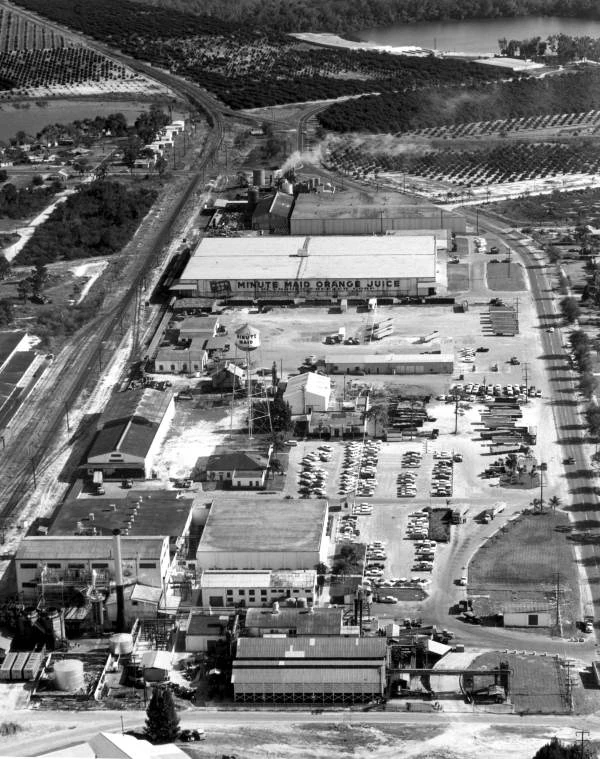
Open your freezer and there’s a fair chance that, somewhere in the last seventy years, a little cardboard can of frozen orange juice sat in it — the kind you thaw, dump into a pitcher, add a few cans of water, and stir back into juice. That whole idea, orange juice you keep frozen and mix yourself, got its start at a plant on the grove land of a place most people have driven past without noticing: Plymouth, Florida, a crossroads northwest of Apopka where Orange Blossom Trail crosses an old railroad.
It is an easy place to miss. A few roads, some groves, a rail line, a cluster of warehouses. But for a stretch of the last century, what happened here sat in kitchens from Maine to California, every morning, poured over ice.
A town that grew up around a train stop
Plymouth started the way a lot of these small Orange County places did — around a stop on a railroad. When the Tavares, Orlando & Atlantic line pushed through in the 1880s on its way from the lakes down to Orlando, a little settlement gathered at the siding and took the name Plymouth, borrowed from the old town up in Massachusetts.

By the late 1880s there was a store, a hotel out by the lake, a Methodist congregation that organized in 1888, and a cemetery association a couple of years older than that. What the town really had, though, was the same thing every town out here had, and more of it than most: land. Flat, sandy, high-and-dry citrus ground, running off in every direction, cheap and waiting for whatever you wanted to plant on it.
Enough of it that a man could do something almost comical with the amount. One of the people who turned up was a Chicago department-store magnate who first came down in 1886 for his wife’s health, decided the rolling ground and the lakes reminded him of the Scottish hills where he’d been born, and simply bought a thousand acres of it. He raised registered cattle on part, planted citrus on another, and put up a three-story house with its own elevator in the middle. He called the whole estate Errol, after home. You did that kind of thing out here because you could. There was room.

For sixty years that was the whole story: groves, and the work that went with them. Pick the fruit, haul it to a packing house, grade it, crate it, ship it north on the same rail line the town had grown up beside. Plymouth was a dot on a very long list of Florida grove towns doing the exact same thing. Nothing about it said it was going to end up famous.

The problem nobody could crack
Here’s the thing about an orange: it is a terrible way to ship vitamin C. Fresh juice spoils in days. The Army found that out in the Second World War, when it wanted to get vitamin C to troops and tried everything — canned juice that tasted cooked, powdered juice that tasted like nothing anyone wanted to drink twice.
The answer came out of a state laboratory down at Lake Alfred, where a handful of scientists working for the Florida Citrus Commission figured out how to pull most of the water out of the juice under a vacuum, cold, without boiling the flavor away. Freeze what’s left, ship the frozen block, and whoever’s on the other end just adds the water back. Frozen concentrate. They had it working right about the time the war ended — which meant the Army didn’t need it anymore, and the thing had no customer at all.
That is where Plymouth comes in. A Boston company that had spent the war dehydrating penicillin and blood plasma for the military went looking for something to do with the same machinery in peacetime. Its man in charge chased an Army contract for powdered orange juice, set up a company, and built a plant out on the grove land at Plymouth to fill it. Then the war ended, and the Army cancelled the order before the first shipment. He had a plant, a payroll, and no deal.
So he bet the whole thing on the idea the government lab had just about given up on: frozen juice you mix yourself.

The first cans went out of the Plymouth plant in the spring of 1946. The company needed a name, so it handed the job to a Boston ad agency, which reached for the one bit of local history everybody knew — the Minutemen — and came back with Minute Maid.

The crooner who sold the country on it
For two years it barely sold. Frozen anything was a hard sell in 1946 — plenty of kitchens didn’t even have a freezer worth the name — and the little can needed somebody to explain what to do with it. Then, in 1948, the company put Bing Crosby on the radio five mornings a week, talking up Minute Maid between songs, and the thing caught fire.
The year before Crosby, the company sold about three million dollars of juice. Three years later it was close to thirty. Crosby and his family kept making Minute Maid ads for nearly thirty years, right up until he died. A grove-town plant northwest of Apopka was now a brand people hummed along to.
By 1960 it was big enough that Coca-Cola bought it outright — the first time Coke had ever stepped outside soft drinks. The crossroads had, improbably, produced a national habit. For a long stretch, a good share of the orange juice in America’s freezers traced back to this one spot on the map.
What’s left on the ground
The plant stayed. Even after the headquarters moved off to Texas, the company’s national research center sat for decades on the original site, on Orange Avenue in Plymouth, the same ground where the first frozen cans were packed. The land is still Coca-Cola’s.
And the room that made all of it possible is doing what it has always done — getting used for whatever the moment needs. The groves that once ran to the horizon out here have mostly given way to something else; these days the big open parcels along the highway hold distribution warehouses, the kind with a national name on the side and a loading dock a quarter-mile long. Different cargo, same reason it’s here. There was space to build something large next to the road.

Coca-Cola has said it’s winding down the frozen juice line now — the little can is nearly gone, pushed out by the carton of ready-to-pour juice it taught everybody to want in the first place. But the habit it started outlived the can. And it started on a patch of grove room at a crossroads named after a town in Massachusetts, for the plainest reason there is: somebody had the space to put a plant right next to the fruit, so that’s where they put it.