Paradise Heights, Florida  ·  A Local History

They Named It Paradise
for the Fishing


Up where Apopka runs into Ocoee there’s a quiet, big-lotted place called Paradise Heights. The lake just down the hill was once the largemouth-bass capital of the world — and then it became the most polluted big lake in Florida. This is what happened to the paradise, and the one thing it kept.

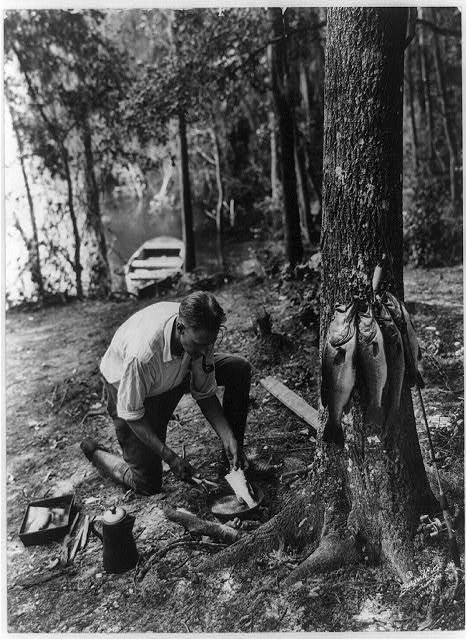
A man in shirtsleeves kneels at a lakeside camp cleaning his catch over a small fire, a stringer of four large bass hung on a pine tree beside him and a wooden boat pulled up on the shore behind.
Camping on a Florida lake — the whole idea
What people drove here for. A camper cleaning a day’s catch beside a Florida lake, a string of big black bass hung on the tree. “Black bass — good to catch — good to eat. Camping on a Florida lake,” circa 1925; Library of Congress, Prints & Photographs. A representative Florida lake-fishing scene from the era, not Lake Apopka specifically.

Drive through Paradise Heights today and it’s easy to miss. Big lots. A horse or two. Orange trees gone half-wild along a fence line. A bass boat on a trailer in somebody’s side yard. That boat is the whole story, and you’d never guess it.

Because the lake just down the hill — Lake Apopka — was once one of the best places in America to catch a largemouth bass. People drove across the country for it. And then, inside about one lifetime, that same lake became the most polluted big lake in the state of Florida.

So the name isn’t a joke somebody played on a subdivision. For a good long while, Paradise was just the truth of the place. The question is what made it a paradise — and what broke it.

The lake everybody was chasing

Before the theme parks, before the toll roads, the thing that first put this part of Florida on the map was water. Mapmakers called it the “Lake Region” — a scatter of big shallow lakes strung through Orange, Lake and Sumter counties, with railroads racing each other to connect them. You can see it on an 1885 map: lines converging on little lakeside stops like Apopka and Zellwood.

An 1885 color map of central Florida showing Orange, Sumter and surrounding counties, with Lake Apopka, Apopka, Zellwood, Orlando, Sanford and dozens of small lakes, and rail lines converging on them.
The “Lake Region” — 1885
Where the whole region started. Rail lines racing to reach the lakes of Orange County — Lake Apopka at left, with Apopka, Zellwood, Orlando and Sanford. Detail from “New Map of Florida… Showing the Railway Connections with the ‘Lake Region’ and Zellwood,” T. Ellwood Zell, 1885. Library of Congress, Geography & Map Division.

Lake Apopka was the giant of them — one of the biggest lakes in Florida, and shallow as a soup bowl. Warm, weedy, sunlit all the way to the bottom. If you wanted to design a factory for growing fat largemouth bass, you’d build Lake Apopka.

And the fishermen found it. By the 1920s and ’30s they were coming from all over the country, and somebody started calling it — out loud, in print — the largemouth-bass capital of the world. More than twenty fish camps grew up around the shoreline to catch the business: docks, bait, a few rental cabins, a man who’d run you out to the good water and back. One whole stretch of shore was called, with no irony at all, Fishermen’s Paradise.

The settlement up on the ridge

Paradise Heights sat on the high ground just above all that — a sandy rise over the lake, which is where the “Heights” part comes from. Three of those fish camps were its own.

Tall, widely spaced longleaf pines beside a sandy road running back into the woods, with a small horse-drawn buggy far down the road.
High, sandy, dry — the “Heights”
Why it sat up here. The ridge above the lake was high, well-drained pine-and-sand country — the good ground to build and plant on. “In the Pine Woods, Florida,” Detroit Publishing Co., 1904; Library of Congress. A representative Central-Florida scene.

The people who settled that rise did what everybody did out here with a piece of ground: they used all of it. Orange groves on the high, well-drained sand. A few head of cattle. A garden big enough to matter.

Straight rows of orange trees heavy with ripe fruit running back toward a lake and a pale sky, in tinted color.
Groves on the high ground
The crop the ridge was made for. Citrus wanted exactly what Paradise Heights had — high, sandy, frost-draining ground above the water. A Florida grove heavy with fruit, “Lake Region, Florida,” Detroit Publishing Co., 1908; Library of Congress. A representative Central-Florida grove.

And because the lots were big and the county was mostly empty, people built whatever the place needed. A packing shed for the fruit. A second little house out back for family, or for a grove hand. A cabin to rent to a winter fisherman who’d come down for the bass. The room out back wasn’t decoration. It was where the next useful thing went.

A small rustic log cabin with a wood-shake roof and a tall stick-and-mud chimney, a palm and pines beside it, and a figure in the doorway.
A second little house out back
Build what you need on the ground you’ve got. A Florida homestead cabin of the kind raised as a grove-hand’s house, a guest place, or a cabin to rent. “Old Cabin at Turkey Creek,” Detroit Publishing Co., 1880; Library of Congress. A representative Florida homestead, not Paradise Heights itself.

Years later, Orange County made that habit official. In 1991 it drew a line around Paradise Heights and a handful of places like it and called them Rural Settlements. Out here lots stay big, the county doesn’t run city water and sewer in, and a place that’s technically just an old platted subdivision gets to go on acting like country — even wedged, as Paradise Heights is, right between the growing cities of Apopka and Ocoee.

What broke the paradise

Then the thing that made the lake died, and it’s one of the saddest and most avoidable stories in Florida.

Back in the war years, the government helped throw a levee across the shallow north end of Lake Apopka and drain the marsh behind it to grow vegetables in the black muck left on the bottom. Celery, mostly, and sweet corn. They were good crops, and the soil was some of the richest in the state.

A crew of farm workers harvesting celery across a wide muck field, bundling stalks into wooden crates beside a long barn, with more workers and crates stretching into the distance.
Celery off the black muck
The farms that fed the lake its poison. The drained lake bottom became some of the richest vegetable ground in Florida — and every season the fields were flooded and the fertilizer-loaded water pumped back into the lake. “Harvesting celery, Sanford, Florida,” 1937; Farm Security Administration, Library of Congress. A representative Central-Florida muck-farm harvest.

Here was the catch. Every season the farms would flood those fields and then pump the water — loaded with fertilizer — straight back into Lake Apopka. Year after year after year. The lake couldn’t take it.

The clear water went pea-green with algae. The underwater weeds the bass lived and spawned in died off in the gloom. By the mid-1960s there were fish kills you could smell from the road, and the trophy bass gave way to rough fish nobody drives anywhere to catch. The camps started closing. By the mid-’70s you could count what was left on the whole lake on one hand. Paradise Heights’ three were gone, and so were the winter fishermen who’d rented those cabins out back.

A high aerial view of Lake Apopka: a large pale shallow lake with developed suburbs along its southern and eastern shores and flat, squared-off former farm fields along the far north shore.
You can still read it from the air
The whole story in one frame. Lake Apopka from above — the big shallow lake, the towns crowded along the near shore, and the flat, dead-straight former farm fields on the far north shore that drained the marsh and fed the lake its fertilizer. Aerial over Lake Apopka, 2012 (modern photograph); Michael Adams, via Wikimedia Commons.

A place named Paradise lost the one thing it was named for — and stayed Paradise anyway.

The part still being written

In the 1990s the state did something expensive and genuinely unusual: it bought the farms. Not one or two — the whole north shore, every acre, so no more fertilizer water could go back in.

Then it got stranger. Biologists hauled the rough fish out by the truckload and stocked the lake back up with bass. They started flooding the old vegetable fields back into marsh on purpose, letting the water plants return. And slowly — this is the surprising part — the lake began to come back.

A river otter lifts its head out of weedy blue water near a grassy shoreline, looking toward the camera.
Back on the restored north shore
Life moving back in. A river otter on the restored north shore of Lake Apopka, where vegetable fields are becoming marsh again. Lake Apopka North Shore, 2016 (modern photograph); Libardo Lambrano, via Wikimedia Commons (CC BY 3.0).

Today there’s a drive that runs for miles out across that restored north shore, and it has turned into one of the best places in Florida to count birds — egrets, ibis, whistling-ducks, and an otter if you’re paying attention.

A great egret, brilliant white with a yellow bill, picking its way through tall green marsh grass in bright sun.
The birds came first
A paradise again — for different visitors. A great egret on the Lake Apopka Wildlife Drive, now one of Florida’s top birding spots. Lust Road gate area, 2023 (modern photograph); The Bushranger, via Wikimedia Commons (CC BY-SA 4.0).

And the fish are following the birds back. Not all the way back — a lake takes longer to heal than it does to break — but closer every year. The bass boats are showing up on the ramps again.

A large Florida largemouth bass held just above the water, mouth open, in bright daylight.
The reason it was Paradise
What the whole thing was built on. A Florida largemouth bass — the fish that made Lake Apopka famous, and the one the restoration is bringing back. Modern photograph; Daniel Estabrooks, via Wikimedia Commons (CC0).

So the name turns out to be the true part. The lake that made Paradise Heights a paradise broke, the fish camps that were its reason for being closed one by one, and the little settlement up on the ridge is still sitting there anyway — quiet, big-lotted, groves gone shaggy, a bass boat on a trailer in the side yard, waiting on a lake that’s finally turning back into something worth the trip. Whatever else Paradise lost, it never lost the room.

A present-day note · Orange Tiny Homes

The best thing on a big lot is usually the room itself.

Paradise Heights was built on one plain rural-Florida habit: when you’ve got ground, you put something useful on it. The ridge families set out groves, ran a few cattle, and built a second little house out back — for family, for a grove hand, or to rent to a fisherman down for the season. The room out back was never just a view. It was where the next thing went.

That instinct still pays, and these days the thing people build out back has a name — an ADU, an accessory dwelling unit — and it’s what we build. A granny flat so a parent can live close with their own front door. A guest house. A rental out back that helps carry the mortgage. A tiny home on the far corner of the lot. Same idea those roomy Paradise Heights lots were settled on, just with a kitchen, a bathroom, and a permit.

And you don’t need a grove-owner’s acreage to do it. Across greater Orlando — the big rural lots out by Paradise Heights, Zellwood, Tangerine and Clarcona, sure, but also ordinary yards in Apopka, Ocoee, Winter Garden and Pine Hills — plenty of homes already have the space. What actually decides it comes down to your own address:

The real answer to “is there room out back for this?” isn’t a guess — it’s a handful of facts about your lot. That part we can check for you.

Put in your address and we’ll pull what your parcel allows and tell you whether a granny flat, guest house, rental, or tiny home actually fits — before you spend a dollar on drawings.

Start the ADU Fit Check→
Sources & Photo Credits

On the history

Paradise Heights itself survives in county planning records, an Orange County driving-tour guide, and the Lake Apopka fish-camp histories kept by the Winter Garden Heritage Foundation, rather than in a deep photographic archive of the settlement. Of the images below, none is of Paradise Heights specifically; each is identified in its caption as either a period Central-Florida scene (the lakeside camp, the pine woods, the grove, the homestead cabin, the muck-farm harvest) standing in for what the ridge and the lake looked like, or a modern photograph of Lake Apopka and its restoration (the aerial, the otter, the egret, the bass). The “largemouth-bass capital of the world” phrasing and the three-fish-camp count are reported from the local-history and county sources cited above. Full notes are kept in source-record.md beside this page.

Photographs & maps

  1. Black bass — Camping on a Florida lake — a camper cleaning his catch beside a Florida lake, bass hung on a pine; “Black bass — good to catch — good to eat. Camping on a Florida lake,” circa 1925; Library of Congress, Prints & Photographs Division. Shown as the hero; a representative era scene, not Lake Apopka. File: black-bass-camp-1925. loc.gov
  2. New Map of Florida, 1885 (detail) — central Florida with Lake Apopka, Apopka, Zellwood, Orlando and the rail lines of the “Lake Region”; T. Ellwood Zell, 1885; Library of Congress, Geography & Map Division (via Wikimedia Commons). File: lake-region-map-1885. source
  3. In the Pine Woods, Florida — open longleaf-pine high ground; Detroit Publishing Co., 1904; Library of Congress. A representative regional scene. File: florida-pine-woods-1904. loc.gov
  4. Florida orange grove (“Lake Region, Florida”) — a grove heavy with ripe fruit beside a lake; Detroit Publishing Co. print, 1908; Library of Congress. A representative Central-Florida grove. File: florida-orange-grove-1908. loc.gov
  5. Old Cabin at Turkey Creek — a Florida frontier homestead cabin; Detroit Publishing Co., 1880; Library of Congress. A representative Florida homestead, not Paradise Heights. File: florida-cracker-cabin-1880. loc.gov
  6. Harvesting celery, Sanford, Florida — a crew harvesting celery on black muck soil; 1937; Farm Security Administration, Library of Congress. A representative Central-Florida muck-farm harvest, standing in for the Lake Apopka north-shore vegetable farms. File: muck-celery-harvest-1937. loc.gov
  7. Lake Apopka from the air — aerial of the lake with its developed southern shore and the former farm fields on the north shore; 2012 (modern); Michael Adams, via Wikimedia Commons (CC BY-SA 3.0). File: lake-apopka-aerial-2012. source
  8. River otter, Lake Apopka North Shore — an otter in the restored north-shore water; 2016 (modern); Libardo Lambrano, via Wikimedia Commons (CC BY 3.0). File: lake-apopka-otter-2016. source
  9. Great egret, Lake Apopka Wildlife Drive — a great egret in marsh grass at the Lust Road gate area; 2023 (modern); The Bushranger, via Wikimedia Commons (CC BY-SA 4.0). File: great-egret-2023. source
  10. Florida largemouth bass — a largemouth held above the water; modern photograph; Daniel Estabrooks, via Wikimedia Commons (CC0). File: florida-largemouth-bass. source

Original downloads and a full research record are kept alongside this page in assets/images/originals/ and source-record.md. The hero and the orange grove are tinted period images; no historical image was altered in any way that changes its content. The Polaroid frames and handwritten notes are CSS added around the images, never onto them. The 1885 map is shown as a cropped detail.