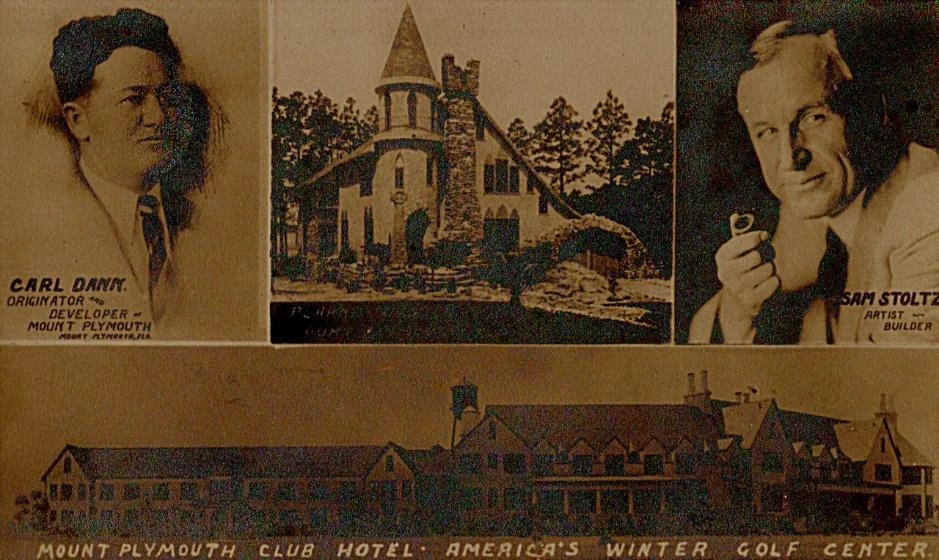
Nobody in Florida has ever had to shift into low gear to climb a mountain, which makes it a little funny that in 1926 a man stood on a sandy rise northeast of Orlando and sold one. He laid out a whole resort city across the high ground past Apopka, pointed at the land rolling off toward the lakes, and named the place Mount Plymouth. The brochures did not hedge. “Here the highlands surround you,” one promised. “The town itself lies upon a broad hilltop plateau.”
It is high ground — for Florida. Come east off the flatwoods and you can feel the car lean back a little as the land lifts onto the old sand ridge that runs up through Mount Dora. But the thing actually for sale was never the hill. It was what the man meant to build on top of it.
He meant to build the winter golf capital of America. And for about a year and a half, it looked like he might.
The man who didn’t think small

His name was Carl Dann, and by the time he got to Mount Plymouth he had already carved something like sixty subdivisions out of the scrub around Orlando and had a hand in Dubsdread, the golf course up in College Park. The 1920s land boom was on, the kind of years when a man could buy a pasture in the morning and sell it platted into lots by supper, and Dann was very good at it.
What he drew up on the ridge was not a neighborhood. It was a resort. The plan called for four eighteen-hole golf courses — one patterned on the Old Course at St. Andrews in Scotland, another named for Gleneagles, two more to follow — laid across the high ground so that a man could, as the booklet put it, play “every day of the year.” At the heart of it he put up a club hotel: a rambling four-story place that cost a third of a million dollars in 1926 money, with what people swore was the largest dining room in the state, and an airfield out back so the right sort of guest could fly straight in.
The club opened in January of 1927. By then the backers were a who’s-who of Orange County — the president of the Orlando golf association, the mayor of Orlando, bankers from Apopka and Ocoee — and the stories that still cling to the place have Babe Ruth and Connie Mack and the gangster Al Capone turning up to play. How much of that guest list is real and how much is the kind of tale a grand old hotel grows on its own, nobody can say for certain now. That part you file under legend and enjoy anyway.

What made the thing unusual wasn’t the ambition — every third promoter in Florida that year was promising paradise. It was the taste. Dann hired a Winter Park artist and builder named Sam Stoltz to design the cottages that would ring the courses, and Stoltz built them like something out of a storybook: steep gingerbread rooflines, hand-troweled plaster, pecky-cypress beams, little chimneys of coquina rock. English, Spanish, Italian, Colonial — no two quite alike. You were not just buying a lot on a golf course. You were buying a part in a picture.

And the land under it all had been something quieter. This was the high orange country — red-clay hills and grove rows that ran east toward the lakes and the big dark Wekiwa River forest three miles off, close enough that the booklet bragged a hunter could walk out of it with a wild turkey, or on a good day a bearskin. Before Dann it was a few dozen families, groves, and a lot of space. He wanted to keep the space and sell the view.

Every day of the year
For a season or two it actually ran. The St. Andrews course grew in across the ridge, the dining room filled, and the sales copy got to brag about the one thing Florida genuinely had over Scotland: you could tee off in January without a coat.

The lots sold the way everything sold that year — in groups, by the lakeful, with the fairway practically running under your bedroom window. Lake frontages for the ones who wanted the water; links frontages for the ones who wanted the game. The place had quail and bass and room to burn, and a developer with a knack for making all of it sound like the start of something national.
Then the thing that was holding the whole state up simply stopped holding.
When the floor fell out
The Florida land boom broke in 1926, and it broke hard. The easy money that had been chasing lots sight-unseen evaporated almost overnight; a hurricane down in Miami that September finished the mood. The buyers Mount Plymouth was counting on didn’t come. Three of the four golf courses were never built. The Gleneagles never got its holes. The resort city that was going to stretch across the ridge stayed mostly lines on a plat.

The hotel, though, was too big and too handsome to just disappear. It limped through the lean years, and in 1959 it found a second life as a boarding school — Florida Central Academy, which put students in the old guest rooms for a quarter of a century. The school finally failed in 1983, tangled in bankruptcy, and the great wooden building was condemned and left to the weather and the local teenagers.
Fire took it in the mid-1980s. The site was cleared. If you drive to the corner where the largest dining room in Florida once was, there is nothing standing to tell you it was ever there — a historical marker, and air.
The grandest thing anyone ever built here is completely gone. The thing it was built on — the room — never left.
What the boom couldn’t take back
Here is the strange gift of a resort that half-happened. Dann platted Mount Plymouth for big, generous lots — houses set well apart, a golf course and a forest for neighbors. Then the money vanished before the crowds could. So the generous lots stayed generous. Nobody came along in the lean years to squeeze them down.

Drive it now and that is exactly what you find. Mount Plymouth never incorporated into a city; it’s still unincorporated Lake County, a few thousand people spread across the old ridge. Out toward Sorrento the lots run to ten and twelve acres, zoned for horses, barns and pasture behind the houses. The streets still carry the names the resort gave them — Westward Ho, Apawamis — borrowed from famous golf courses for a links that was never fully built, the last echo of the pitch.

And a handful of Stoltz’s storybook cottages are still out there under the oaks, lived in, gingerbread roofs and all — worth more now for the charm than any fairway view. The grand hotel is gone. The little houses it was supposed to be a backdrop for are the thing that lasted.

So the man who tried to turn a sand hill into a mountain mostly failed. The golf capital never arrived. But he did leave one thing that held: he cut the land into big, breathable pieces and called it a selling point — and nearly a hundred years later, that is still the best thing about living out here. Not a mountain. Just room, on high ground, with a horse pasture where the ninth hole was going to go.