Lake Crescent Reserve, Gotha / Windermere · Orlando, Florida  ·  A Local History

The First Famous Thing in Orange County Was a Backyard


In a tiny German farm colony called Gotha, a bird expert from Milwaukee turned the acreage behind his cottage into one of Florida's first real gardens, and the whole country came to see it. The brilliant caladium leaf you have seen in planters all over the state started right there, in the room out back.

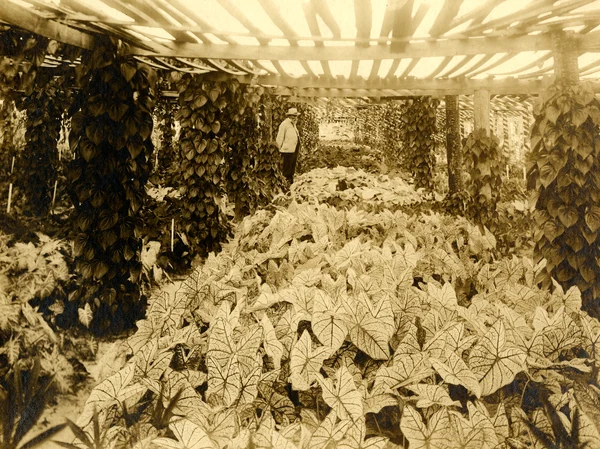
A man stands inside a long slat-roofed lath house in 1908, the ground around him a dense carpet of broad caladium leaves stretching into the shade.
Under the lath house, Gotha, 1908
The floor is caladiums. Professor Henry Nehrling among his caladiums in his garden at Gotha, Florida, October 1908, photographed by T. P. Robinson. State Archives of Florida, Florida Memory.

Long before anybody drove to Orange County to see a mouse, they drove out to see a garden. Not a public park. Not a tourist nursery. A private backyard, behind a wooden cottage, in a little German farm colony called Gotha that most people in Orlando couldn't quite find on a map then and couldn't now.

The man who owned it was not a farmer or a developer. He was a bird expert from Milwaukee with weak lungs and a good notebook, and the thing he planted on the acreage out back ended up changing what the whole state looks like. That hand-painted red-and-green caladium leaf you have seen in a hundred Florida planters, the one that looks almost too bright to be real, traces straight back to the room behind his house.

So here is the question this place answers, if you let it. How does a backyard, in a town nobody has heard of, become the first thing people in Central Florida bragged about seeing?

The bird man who came south

A color book plate of several warblers perched among green leaves and red berries, captioned in both German and English as warblers in their winter quarters.
His first life’s work: birds
Before the plants, the birds. A color plate from Henry Nehrling’s Our Native Birds of Song and Beauty, the songbird book that first made his name. Public domain, via Wikimedia Commons.

His name was Henry Nehrling, and his first fame had nothing to do with plants. He ran the public museum up in Milwaukee and wrote a thick, beautiful book on American songbirds, the kind with color plates people cut out and framed. Birds were the whole thing. Then his health and a Florida land boom pointed him south, and in the mid-1880s he bought a piece of ground in Gotha, a colony of German freethinkers who had come to grow oranges on the high sandy ridge west of Orlando.

He meant it as an orange grove and a place to rest his lungs. He got a laboratory instead.

A formal portrait of an older man with a full white beard, in a dark three-piece suit, standing with one hand resting on a closed book on a table.
Henry Nehrling, plant man of Gotha
The man himself. Dr. Henry Nehrling (1853–1929), ornithologist and horticulturist, who built Palm Cottage Gardens on his land in Gotha. State Archives of Florida, Florida Memory.

What changed him was a single afternoon at a world’s fair. In 1893 Nehrling went up to Chicago for the great Columbian Exposition, the one with the white domes along the lagoon, and he wandered into the Horticultural Building to get out of the crowd.

The leaf he couldn’t put down

An 1890s photograph of a long exposition building topped by a huge glass dome, seen across a lagoon with a small rowboat, captioned Horticultural Building from Wooded Island.
Where it started: Chicago, 1893
Under that glass dome, he met the caladium. The Horticultural Building at the 1893 World’s Columbian Exposition in Chicago, from a published plate of the fair. Public domain, via Wikimedia Commons.

Inside, under glass, were tropical plants nobody up north had ever seen, and one of them stopped him flat. It was the fancy-leaved caladium from Brazil, a plant grown for nothing but its leaf, and the leaves came in reds and pinks and whites, veined and splashed like a piece of stained glass. A plant that looked like a flower all over, year round.

He had to have them. Through a dealer with South American connections he got hold of hundreds of Brazilian caladiums, and he carried that one obsession home to the sandy acre behind his cottage in Gotha.

A botanical illustration of a caladium plant, its large arrow-shaped leaves colored deep red at the center fading to green at the edges, with a pale flower spike at the base.
The whole plant is the leaf
Grown for color, not flowers. A botanical plate of the fancy-leaved caladium (Caladium bicolor), the Brazilian plant Nehrling built his garden around. Wellcome Collection, via Wikimedia Commons.

What he built on that ground, over the next thirty years, became one of the first real plant-testing gardens in the state, and the federal government leaned on it. He would grow out something odd from the far side of the world, bamboo from China, amaryllis, a palm, a leaf nobody had dared in this soil, and watch what lived through a Gotha summer and what the cold took in winter. Something like three thousand kinds of plant passed through his ground. A few hundred of them stuck, and quietly became the ordinary furniture of Florida yards.

The caladiums ran away with him. At the top of it he had something close to seventeen hundred named kinds of them growing under a lath house, a long shed roofed in wooden slats so the sun would not scorch the leaves, the floor below one solid quilt of color. That is the room at the very top of this page.

Word got out

An early-1900s sepia photograph of an automobile on a sandy country road passing a modest house set back among tall pines, open ground on both sides.
The kind of road they came down
A cottage at the end of a sand road. A rural Florida homestead on an unpaved road, from a 1914 Florida railway booklet, the sort of lane that led out to the farm colonies west of Orlando. Public domain, via Wikimedia Commons.

A thing like that does not stay quiet for long. Plant people started making the trip out to Gotha the way you would make a pilgrimage, and the names got large. David Fairchild, the government’s great plant explorer, came to see it. Liberty Hyde Bailey, about the most important garden writer in the country, came. By the account the place keeps on itself, Theodore Roosevelt turned up at the gate too. For a stretch of years the most talked-about address in Orange County was a cottage at the end of a dirt road, in a German farm colony, and the attraction was a man’s backyard.

The most famous address in the county was a backyard at the end of a sand road.

Then the cold came for it

A man in a hat stands among rows of orange trees that have been killed and cut back to bare, leafless stumps on open, scrubby ground after a hard freeze.
What a hard freeze leaves
Florida settles its accounts in winter. A grower among the stumps of a Florida grove killed by a hard freeze, a representative scene of the cold that broke tender plantings. State Archives of Florida, Florida Memory.

Florida has a way of settling accounts with anyone who gets comfortable growing tender things. A hard freeze in 1917 came down the peninsula and took most of it, the tropical collection Nehrling had spent decades pulling together, gone in a couple of nights.

So he did the thing Florida growers have always done after a freeze. He went farther south. He started a second garden down near Naples, on the bet that the cold simply could not reach that far, and moved what he could save. That southern garden outlived him, too. It is the Naples Zoo now.

The leaf outran the man

A present-day field of caladiums grown in long rows, broad red and pink and green leaves stretching to the horizon under a blue Florida sky.
Caladiums, now grown by the field
What started in a backyard, grown by the acre. A commercial caladium field in central Florida today. Modern photograph; present-day scene, shown to carry the story forward.

Nehrling died in 1929, and you would expect a private garden in a town nobody has heard of to die with him. The garden nearly did. The leaf did not. The caladium he dragged home from a world’s fair turned into a Florida crop, then a Florida industry. Nearly every caladium bulb sold in this country is now grown a couple of hours south of Gotha, around a town called Lake Placid that calls itself, without much argument from anyone, the caladium capital of the world. The thing one man was obsessed with in his backyard is now a thing people grow by the field.

What’s still out there

The restored two-story white wood Palm Cottage today, a covered porch and upper balcony, framed by tall bamboo and a bed of bromeliads in the foreground.
Palm Cottage, still on Hempel Avenue
The core survived. Nehrling’s Palm Cottage and the oldest of his plantings today, kept as a historic garden on Hempel Avenue in Gotha. Photograph courtesy of Nehrling Gardens.

The heart of it survived. A few acres of Nehrling’s ground, the old cottage and the oldest of his trees, are still there on Hempel Avenue in Gotha, kept up as a historic garden you can walk through on an afternoon. It sits in the same small community that Lake Crescent Reserve belongs to, on the same high sandy ridge, carrying the same old habit: a generous piece of ground, with room out back to try something on.

Which is the quiet point of the whole story. The first famous thing in Orange County was not a building, or a beach, or a ride. It was what one stubborn man did with the room behind his house. He had the ground, so he filled it with the thing he could not stop thinking about, and people drove out to a dirt road in Gotha to see it.

A present-day note · Orange Tiny Homes

He had room out back and built the thing he couldn’t stop thinking about. You’ve got the same room, and the same question.

Nehrling’s whole story runs on one old Central Florida fact: out here you get a generous piece of ground, and the interesting part is what you do with the room behind the house. He filled his with caladiums. The growers before him filled theirs with orange trees. The question has not changed. You have the ground, so what do you put on it?

These days the useful answer has a name, an ADU, an accessory dwelling unit, and it is what we build. A granny flat so a parent can live close with their own front door. A guest house. A small rental cottage out back that helps carry the place. A tiny home in the far corner of the lot. The same instinct Gotha was built on, just with a kitchen, a bathroom, and a permit.

And you do not need Nehrling’s acreage for it. The roomy lots around Gotha and Windermere, sure, but also ordinary yards in Ocoee, Winter Garden, Conway, and Pine Hills, plenty of them already have the space. What actually decides it comes down to your own address:

The real answer to “is there room out back for this?” is not a guess. It is a handful of facts about your lot, and that part we can check for you.

Put in your address and we will pull what your parcel allows and tell you whether a granny flat, guest house, rental, or tiny home actually fits, before you spend a dollar on drawings.

Start the ADU Fit Check→
Sources & Photo Credits

On the history

What is documented and what is representative: the two Nehrling photographs and the surviving Palm Cottage are specific to this story. The caladium botanical plate, the 1893 Horticultural Building, the frozen grove, and the rural homestead road are period or subject images used to show the plant, the fair, the kind of freeze, and the kind of country around the colony, and are each labeled for what they are. The caladium field and the Palm Cottage exterior are present-day photographs, labeled as modern. Figures for acreage, plant counts, and caladium varieties vary slightly between sources and are given as the commonly reported ranges. Full notes are in source-record.md beside this page.

Photographs

  1. Nehrling among his caladiums, Gotha, 1908 (hero): Professor Henry Nehrling in the lath house of his garden in Gotha, October 12, 1908, photographed by T. P. Robinson; State Archives of Florida, Florida Memory (Koreshan Unity collection). File: nehrling-in-garden-gotha-1908. floridamemory.com/items/show/257876
  2. Plate from Our Native Birds of Song and Beauty: a color plate of warblers from Henry Nehrling’s songbook; public domain, via Wikimedia Commons. File: nehrling-bird-plate. commons.wikimedia.org
  3. Portrait of Dr. Henry Nehrling: State Archives of Florida, Florida Memory. File: nehrling-portrait. floridamemory.com/items/show/258083
  4. Horticultural Building, World’s Columbian Exposition, 1893: the domed glasshouse where Nehrling encountered the fancy-leaved caladium; published exposition plate, public domain, via Wikimedia Commons. File: chicago-1893-horticultural-building. commons.wikimedia.org
  5. Caladium bicolor botanical plate: a botanical illustration of the fancy-leaved caladium; Wellcome Collection (CC BY 4.0), via Wikimedia Commons. File: caladium-chromolith. commons.wikimedia.org
  6. Rural Florida homestead road, 1914: an automobile on an unpaved country road passing a house among the pines, from a Florida East Coast Railway booklet; “no known restrictions,” via Wikimedia Commons / Internet Archive. File: rural-florida-homestead-road-1914. commons.wikimedia.org
  7. Frozen-out orange grove: a grower among the stumps of a Florida grove killed by a hard freeze, a representative image of the cold that broke tender plantings; State Archives of Florida, Florida Memory. File: freeze-grove-remains. floridamemory.com/items/show/26088
  8. Caladium field, central Florida (modern): a present-day commercial caladium field. File: caladium-fields-today. Present-day photograph.
  9. Palm Cottage today (modern): Nehrling’s restored Palm Cottage and garden on Hempel Avenue, Gotha; photograph courtesy of Nehrling Gardens. File: nehrling-palm-cottage-today. nehrlinggardens.org

Original downloads and a full research record are kept alongside this page in assets/images/originals/ and source-record.md. No historical image was altered in a way that changes its content. The Polaroid frames and handwritten notes are CSS added around the images, never onto them. The bird plate and the caladium plate are printed illustrations, labeled as such; photographs are labeled with their date or as modern.