Lake Buynak Estates, Orange County, Florida  ·  A Local History

The Lake With a Name From the Other Side of the World


West of Orlando the lakes are named like a family Bible. Butler. Down. Bessie. Louise. Then, out past the groves, there is a small one called Buynak, carrying a name that came off a map of the Carpathian borderland near Lviv. How it ended up on the water in orange country is really the story of what this land was for.

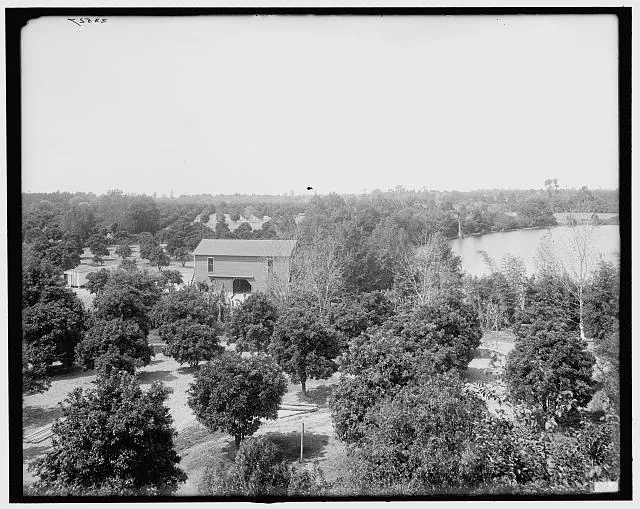
An early photograph looking across the tops of an orange grove near Orlando toward a packing barn and the open water of a lake behind the trees.
Groves to the water’s edge
Orange country, wrapped around a lake. Orange groves on the shore of Lake Concord, Orlando, Florida, circa 1905. Detroit Publishing Company; Library of Congress Prints and Photographs Division.

Stand on the bank of Lake Buynak, a nine-acre pond tucked into the big lots west of Orlando, and say the name out loud. It does not sound like the lakes around it. The whole west side of Orange County reads like a settler’s roll call: Lake Butler, Lake Down, Lake Bessie, Lake Louise, names that belonged to the families who once owned the ground. Buynak belongs to a different alphabet entirely.

Florida lakes almost always carry the name of whoever held the land around them, often a wife or a child the pioneer wanted on the map. So the name on a lake is usually a clue about who got here first. Which makes this one a small puzzle sitting in plain sight.

Because “Buynak” is not a pioneer-Florida name at all. It comes out of the hill country where Slovakia and western Ukraine run together, the old region of Galicia around Lviv. So here is the question worth standing on the bank to ask: how does a name from the far edge of Europe end up on a lake in a county named for its oranges?

Orange country, lake by lake

Start with what this land actually was. Long before anyone platted a neighborhood out here, the whole west side of Orlando was citrus and open ground. Groves ran right down to the lakeshores, because a big lake holds the day’s warmth and keeps the cold from settling, and the safest place to plant a tender orange tree in Florida was on the shoulder of deep water.

A black-and-white photograph taken inside an orange grove, looking down shaded rows of mature citrus trees with props holding up the fruit-laden branches.
Inside the rows
The crop that built the county. Inside a Florida orange grove, circa 1904. Detroit Publishing Company; Library of Congress Prints and Photographs Division. A representative Central Florida grove of the era.

Orange County took its name from the fruit in 1845, and for the next hundred years that is what the land did for a living. The lakes west of town, strung out toward Windermere and Lake Butler, sat at the center of one of the largest citrus regions anyone had ever planted. A grove was not a quiet orchard. It was a year of work, budding the trees, nursing them through frost and scale, picking and packing and hauling the fruit north before it spoiled.

A grove lane with wooden field crates full of freshly picked oranges sitting in the sandy track between rows of citrus trees.
Packed and waiting on the sand road
A season’s work, boxed by hand. Field crates of oranges in a grove near Lakeland, Florida, 1939. Library of Congress Prints and Photographs Division. Representative of grove work across Central Florida.

Land that paid like that was worth owning, and it was still cheap enough that a person without a dollar of Florida history behind them could buy a piece and go to work. That is the part the pretty subdivision signs leave out. This was not old-money country. It was arrive-and-plant country, and it pulled people from a long way off.

The German town up the road

If a foreign name on this land seems like a fluke, drive a few miles toward Ocoee and you run straight into the proof that it is not. There is a little rural settlement out here called Gotha, and it got that name the same way Lake Buynak got its own: somebody carried it across an ocean and set it down.

An early photograph of a two-story wood-frame house with a railed porch in Gotha, Florida, set among heavy plantings with a tall martin birdhouse pole in the sandy front yard.
Home of H. Nehrling, Gotha, Fla.
A German colony in the pines. The home and garden of horticulturist Henry Nehrling at Gotha, Florida, early twentieth century. State Archives of Florida, Florida Memory.

A German printer named Henry Hempel came to Central Florida around 1879, bought up a thousand acres of mostly unclaimed pine land, and in 1885 laid out a town he named for Gotha, the city he was born in back in Germany. He mailed pamphlets north and across the Atlantic, selling the warm winters, and German families came and made their living in the groves. Hempel ran a sawmill that cut the lumber for the first houses and the crates the oranges shipped in. For a while Gotha was one of only two deliberate German colonies in the whole state.

So the idea of someone from across the water getting a big piece of west Orange County ground and stamping a hometown name on it was not strange out here. It was practically the business model.

A name out of the Carpathians

Which brings us back to the lake. Buynak is an Americanized spelling of a surname from the Carpathian borderland, written in the old country as Bujňák on the Slovak side and traced in Galician church records near Lviv and the town of Drohobych. The people who carried it were Rusyns and Slovaks from the hill villages where those two countries blur together.

A 1920 photograph of a Carpathian village: a dirt road running between wooden houses and a small church steeple, with forested mountains rising behind the settlement.
The country the name came from
Where a name like this begins. A Rusyn village in the Carpathian borderland (Subcarpathian Ruthenia), 1920. National Parliamentary Library of Ukraine, via Wikimedia Commons. Shown to illustrate the surname’s home region, not a specific family.

There is a small joke buried in the word. One reading of the name traces it to the Slovak bujný, meaning lush or exuberant, the way a garden gets in a wet year. Another reads the Galician root as something closer to wild or unruly. A name that means either lush or untamed, depending on who you ask, ended up on a little spring-fed lake in the Florida scrub. The land could have picked a worse match.

Who exactly brought it here, and when, is the kind of thing the county’s plat books hold better than the history books do. What is plain is the shape of it: a name from the far side of the world, settling onto the water the same way the people who carried it settled onto the land, because there was room.

Room was the whole point

And there was so much room. When the groves thinned out toward the edges, the land did not sit empty. It ran cattle. Central Florida was open range well into living memory, scrub and wiregrass and palmetto stretching to a tree line, with cowmen moving herds across ground nobody had fenced.

A photograph of a lone mounted cowboy watching a scattered herd of cattle grazing across flat open Florida plains under a big cloudy sky, a single palm on the horizon.
Open range
Land measured in miles, not lots. A Florida cowman riding herd on open plains, 1949. Keystone View Company; Library of Congress Prints and Photographs Division. A representative open-range scene.

That is the habit this whole corner of the county was built on. When you have room, you put something useful on it. A grove. A herd. A packing shed. A second little house out among the trees for the family or the help. Nobody out here grew up thinking a yard was a decoration. A yard was ground you did something with.

A 1953 topographic map of the Windermere area west of Orlando, showing a chain of lakes including Lake Butler and Lake Down surrounded by large areas of woods and scrub, with only a few roads and the small grid of Windermere town.
West Orange County, 1953 · before the subdivisions
Mostly water and open ground. The Windermere quadrangle, west of Orlando, 1953. U.S. Geological Survey. The lakes and scrub just south of Lake Buynak, a generation before the estates were platted.

Look at this corner of the county the way the government mapped it in 1953 and you see what people were buying into: a handful of lakes, a thin scatter of roads, and a great deal of green nothing. Then the 1970s came. The groves that the freezes and the taxes had finally worn down got surveyed into big estate lots, and neighborhoods like Lake Buynak Estates went up on them, most of the houses dated 1973 to 1978. The lots stayed large on purpose. People moving out here wanted the room the groves had left behind.

What the groves left

Go looking for the groves now and you will mostly find lawns and lake views. But the thing those groves were planted on is still here, because you cannot pave over an acre of room. The lots out this way run deep. The lakes are still the center of everything. And the oldest pieces of the story are still standing if you know where to look.

A small white wood-sided one-room schoolhouse with a metal roof, built in 1890, standing today among green trees in Windermere, Florida.
The 1890 schoolhouse, still here
A small building that outlasted the groves. The 1890 Windermere School, photographed in the present day. Photograph by Ebyabe, 2007; Wikimedia Commons (CC BY 2.5).

Windermere kept its little 1890 schoolhouse. Gotha kept the garden that the old horticulturist planted behind his house, open to anyone who wants to walk it. These were never grand buildings. They were the useful, human-sized things people put up on their own ground, and they are the parts that lasted.

A two-story wood-frame house with a deep porch in Gotha, Florida, surrounded by bamboo, palms and heavy tropical plantings, photographed in the present day.
Nehrling’s place, grown up
The same Gotha ground, a century on. Palm Cottage Gardens, Henry Nehrling’s former home and garden in Gotha, present day. Photograph by Ebyabe, 2007; Wikimedia Commons (CC BY 2.5).

The groves are gone and the open range is fenced. The one thing nobody could take off this land was the room.

So the name on the lake makes sense after all. It stuck because this was a place with space to spare, where a person could arrive from the other side of the world, get a real piece of ground, and build what they needed on it. The oranges were only ever the first thing worth putting on all that room.

A present-day note · Orange Tiny Homes

That room out back is still the best thing on the lot.

A preserved Florida cracker-style log homestead cabin with a deep front porch and a tin roof, raised on short piers, standing in a clearing among pine trees.
A plain house on your own ground

Everything out here got built on one plain idea: when you have room, you put something worth having on it. For a hundred years that meant a grove, a herd, or a second little house out among the trees. The groves are gone. The habit, and the room, never left.

These days the useful thing people build on that room has a name, an ADU, an accessory dwelling unit, and it is what we build. A granny flat so a parent can live close with their own front door. A guest house. A rental cottage out back that helps carry the place. A tiny home on the far corner of a big lot. It is the same instinct the grove families had, just with a kitchen, a bathroom, and a permit.

And you do not need lakefront acreage for it. The roomy lots around Windermere and Gotha, sure, but also ordinary yards in Conway, Pine Hills, Azalea Park and Meadow Woods all over greater Orlando. Plenty of homes already have the space. What actually decides it comes down to your own address:

The real answer to “is there room out back for this?” is not a guess. It is a handful of facts about your lot, and that part we can check for you.

Put in your address and we will pull what your parcel allows and tell you whether a granny flat, guest house, rental, or tiny home actually fits, before you spend a dollar on drawings.

Start the ADU Fit Check→
Sources & Photo Credits

On the history

What is documented and what is representative: no historical photographs of Lake Buynak itself are known to survive in public collections, and this page does not present any image as a picture of that specific lake or of any private family. The citrus, grove-work, and open-range photographs are genuine Central Florida images of the period, used to show the kind of country this was; each is labeled as representative where it is not of the exact spot. The Nehrling photograph is a genuine historical image of Gotha; the Windermere schoolhouse and Palm Cottage Gardens photographs are present-day. The Carpathian village photograph illustrates the surname’s home region and is not claimed to be any particular family’s village. Full notes are in source-record.md beside this page.

Photographs & map

  1. Orange groves on Lake Concord, Orlando (hero): groves running down to a lake near Orlando; circa 1905; Detroit Publishing Company; Library of Congress Prints and Photographs Division. File: hero-grove-lake-orlando-c1905. loc.gov
  2. Inside a Florida orange grove: shaded rows of propped citrus trees; circa 1904; Detroit Publishing Company; Library of Congress Prints and Photographs Division. Representative Central Florida grove. File: grove-interior-c1904. loc.gov
  3. Field crates of oranges, near Lakeland: boxed fruit in a grove lane; 1939; Library of Congress Prints and Photographs Division. Representative grove work. File: grove-picking-1939. loc.gov
  4. Home of Henry Nehrling, Gotha: the horticulturist’s house and garden in the German colony of Gotha; early twentieth century; State Archives of Florida, Florida Memory. File: nehrling-home-gotha. floridamemory.com
  5. Carpathian village, Subcarpathian Ruthenia: a village street and church in the Carpathian borderland the surname comes from; 1920; National Parliamentary Library of Ukraine, via World Digital Library / Wikimedia Commons (public domain). Illustrative of the region, not a specific family. File: carpathian-village-1920. commons.wikimedia.org
  6. Open-range cattle, Florida: a cowman riding herd on open plains; 1949; Keystone View Company; Library of Congress Prints and Photographs Division. Representative of Florida open range. File: florida-open-range-1949. loc.gov/item/2018647229
  7. Windermere quadrangle, 1953 (map): the lakes and open land west of Orlando a generation before the estates were platted; U.S. Geological Survey Historical Topographic Map Collection (public domain). File: topo-windermere-1953. USGS topoView
  8. 1890 Windermere School: the surviving one-room schoolhouse, present day; photograph by Ebyabe, 2007; Wikimedia Commons (CC BY 2.5). File: windermere-school-today. source
  9. Palm Cottage Gardens, Gotha: Henry Nehrling’s former home and garden, present day; photograph by Ebyabe, 2007; Wikimedia Commons (CC BY 2.5). File: gotha-gardens-today. source
  10. Preserved Florida cracker homestead: a plain log homestead cabin of the kind Florida settlers built on their own ground, preserved at a state park museum, present day; photograph by Ebyabe; Wikimedia Commons. Representative vernacular building, not a Lake Buynak structure. File: cracker-homestead-today. source

Original downloads and a full research record are kept alongside this page in assets/images/originals/ and source-record.md. No historical image was altered in any way that changes its content. The Polaroid frames and handwritten notes are CSS added around the images, never onto them.