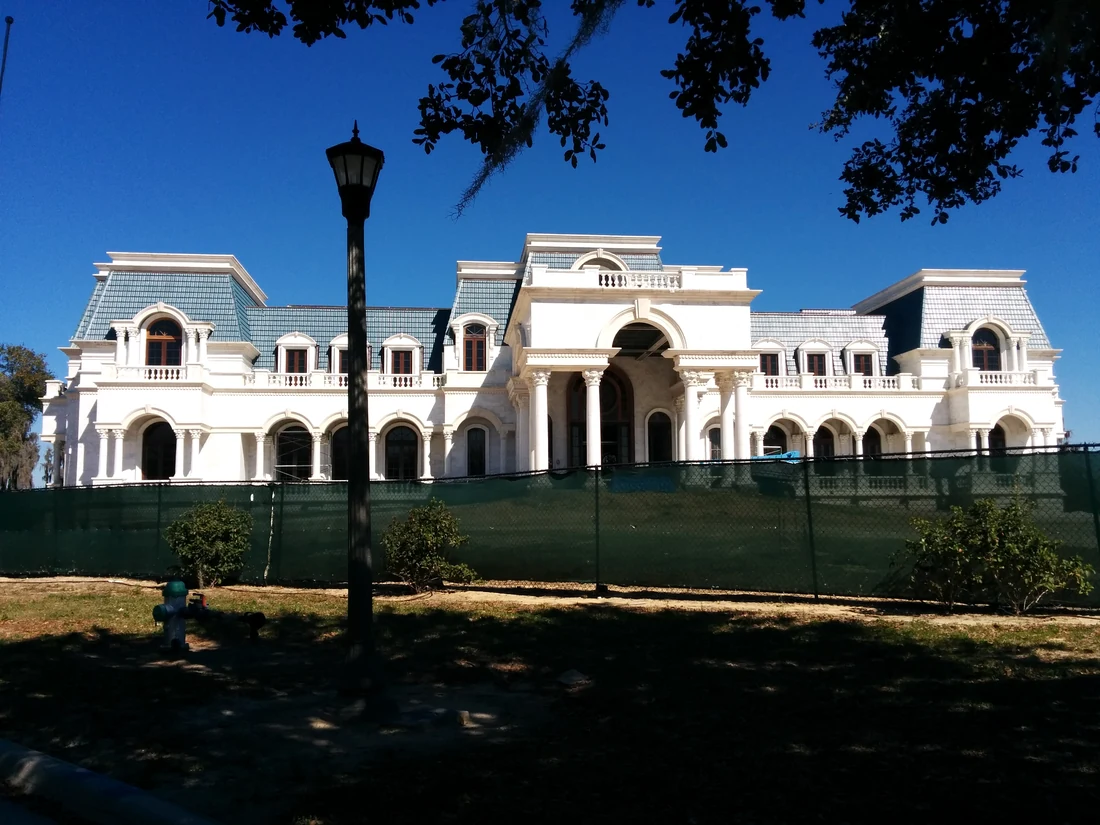
There’s a guardhouse off a quiet road near Windermere, on a gated shore called Lake Butler Sound, and behind it is a house that has been not-quite-finished for more than twenty years. It is enormous, the kind of enormous you can’t take in from the ground. If it ever gets a certificate of occupancy, it will be, by most counts, the largest single-family house in America. The people who built it named it Versailles, after the palace outside Paris, and they meant it.
So here’s the thing a normal person wonders driving past that fence: who decides they need a house that big, and why on earth would they put it here, on a lake in Orange County?
Ninety thousand square feet of “more”
Start with the scale, because the scale is the whole personality of the thing. The plans call for about 90,000 square feet under roof. Fourteen bedrooms. A ballroom meant to hold up to a thousand people. Three indoor pools. A bowling alley. And, the detail that sticks with you, thirty-two bathrooms, which is more toilets than most Florida subdivisions start with.
It was modeled on an actual French palace. Not “palace-inspired” the way a builder slaps columns on a tract home. The owners went to Versailles and the top of the Paris Las Vegas casino and came home wanting both, at full size, on their own lakefront. A dome. A grand staircase. A master suite bigger than a nice house all by itself.

You don’t build that by accident, and you don’t build it on a teacher’s salary. So where did the money come from?
The timeshare king
From selling people a week. David Siegel started a resort company called Westgate in the early 1980s with a single small building, and he turned it into the largest privately held timeshare operation in the world, the business of selling a few days a year of a Florida vacation to a few hundred thousand families at a time. It is a machine that runs entirely on confidence and credit, both the buyer’s and the company’s. When money is cheap and everybody feels rich, it prints.

Ground broke on the house in 2004, right at the top of the boom. For a few years the money was there and the walls went up fast: the dome, the frame, the bones of a palace on the lake. And then, in 2008, the confidence the whole business ran on simply evaporated.
The winter the money froze
When the credit markets seized in 2008, Westgate’s lines of financing seized with them. A company that sells tomorrow’s vacations needs today’s loans to keep the lights on, and suddenly the loans were gone. There were layoffs, surrendered properties, a scramble to survive. And the house on the lake just… stopped, somewhere around sixty percent done, a vast gray shell behind a fence, rooms roughed in and open to the weather.
For a while they put it up for sale. Finished or not, the biggest house in America, yours for around sixty-five million dollars. Nobody who wanted it that badly turned up, and the family decided to keep it and finish it themselves, slowly, out of pocket, as the business clawed back.

That pause is how most people first heard of the place. A documentary crew had started filming the family while the house was going up, expecting a story about building a palace; what they got instead was a story about the floor dropping out. The film came out in 2012 and it gave the family a nickname that stuck better than their own: the Queen of Versailles, and her unfinished castle.
The man who never got to live in it
The finishing took a very long time. Stop, start, stop again. More than twenty years after that first foundation permit, the inside is finally mostly done: the ballroom, the kitchens, the ten-thousand-square-foot master suite, the four-thousand-square-foot closet. By 2026 the work left is mostly the outside: the pools, the stonework, the landscaping on ten acres of lawn.

David Siegel died in April of 2025, at eighty-nine, with the house still not signed off. His wife has said they wheeled him through the nearly finished rooms a few weeks before the end, so he could see the boys had taken over and gotten it this far. He was proud of it. He never got to live in it. The biggest house in America outlasted the man who wanted it, which is a very old story told in a very new building.
His widow says the plan now isn’t really to live in all of it either. It’s to open the ballroom and the grounds for charity galas, with the rental fees waived so more of the money goes to the cause. A palace built as the ultimate private address, ending up as a place you lend out. The room, it turns out, was always looking for a use.
Why anyone wanted room on this lake
Step back from the fence and the thing makes more sense. Lake Butler Sound sits on the Butler Chain, more than a dozen clear lakes stitched together by canals you can take a boat through, the biggest of them well over a thousand acres of open water. People have wanted room on these lakes since long before anyone poured a 90,000-square-foot slab. The house sits on about ten acres with something like twelve hundred feet of its own shoreline. That’s not a yard. That’s a small ranch with a lake for a fence.

Big water is the reason, and it always was. A century ago it was citrus men who prized this ground, because the lakes hold the day’s heat overnight and keep a grove a few degrees warmer when a freeze comes down. The difference between a crop and a ruin. The oranges are long gone. The thing that made the oranges valuable is still right there, lapping at the back lawns.

And the habit behind the whole thing is older than the lake houses too. This part of Florida was settled by people who came down, claimed their acres out in the pine and palmetto, and built what they needed on their own ground: a house, then a barn, then a packing shed, then more as the family grew. The county map was a record of people getting room and putting things on it.

Before the guardhouse and the gala plans, this shore was that: low palmetto and water, ground waiting for somebody to want it. A piece of that quiet still survives right next door, in a preserve where a boardwalk runs out into the hammock on the same chain of lakes.

So the biggest house in America isn’t really a break from anything. It’s the oldest local instinct there is, get room, build what you want on it, run all the way to the end of the road, dome and ballroom and thirty-two bathrooms. The lake it sits on doesn’t care how big the house behind it got. Same water that would have saved a grove, same storms that knocked ten million dollars of damage into the place in a single afternoon in 2022. The house is the largest in the country. It still bows to the lake, same as the smallest cottage on the chain.


