Stand on a dock in Lake Butler Harbor, or anywhere along the chain of lakes in the Dr. Phillips and Bay Hill part of town, and the water is clearly the point. The boats, the big lots, the view down a quiet cove. But for about half a century the view was something else entirely. It was rows. Orange trees in every direction, as far as a person could see, and almost all of it owned by a doctor from Tennessee who, as far as anyone can tell, never once practiced medicine.
His name was Philip Phillips, and everyone called him Doc. The medical degree was real, from Columbia up in New York. What he did with his life was oranges. More of them than anyone else alive.
So here is the question worth standing on a lakefront lawn and asking: how does one man come to own the biggest orange grove on earth, and what happened to all those trees?

The grove that froze, and the one that didn’t
Phillips came to Florida in 1894 chasing the thing half the country was chasing then: a grove of your own in a place where the fruit grew almost by itself. He bought one up near Satsuma. Within a year the Great Freeze of 1894 and 1895 came down the state and killed it to the ground, and like a lot of ruined men that winter, he left.
But he came back. By 1897 he was in Osceola County running cattle, and not long after he bought a grove on the south side of Big Sand Lake, a few miles down the road from where Lake Butler Harbor sits now. That one he kept. And then he started buying the grove next to it, and the one next to that.

The water was the whole bet. A deep lake gives the day’s heat back at night and keeps the shore a few degrees warmer than the land behind it, which on a freezing night is the difference between a crop and a loss. Phillips had learned that the hard way at Satsuma. The second time, he planted where the lakes could cover him.
A grove the size of a county
It is hard, now, to picture how much of this he ended up with. By 1920 he had pulled all of it together under one company and kept going until he was, by the industry’s own count, the largest individual grower of oranges, grapefruit, and tangerines in the world. His groves ran across nine Florida counties. Right here in southwest Orange County, his trees stretched from Conroy Road clear down to the far end of the Sand Lake chain, a solid block of citrus you could get lost in.

A grove that big is not a farm. It is a small country. Somebody has to bud the young trees, fight the bugs, pick the fruit by hand, haul it, grade it, and pack it before it spoils. Thousands of people did that work for Phillips, and a lot of them lived right out in the trees, because there was nothing else out there yet.
So he built them a place to live. Housing for the workers, many of them brought over from the Bahamas, and a post office next to the train station so the mail had somewhere to go. He built a clinic too, for Black workers who were otherwise turned away from the doctors in town. It had its own name on the map before it was anybody’s suburb. The map just said Dr. Phillips.


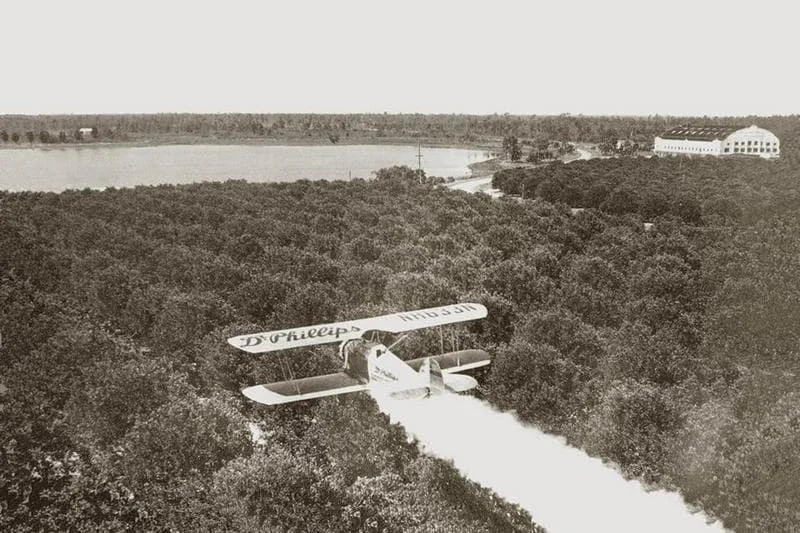
He was restless about the trees themselves, too. When bugs and fungus threatened the groves, Phillips was among the first growers in Florida to hire a plane and spray from the air, which is the strange image at the top of this page: a biplane with his name on the wing, dusting a sea of oranges above a lake, with one of his packing houses sitting on the far shore.
Teaching juice not to taste like a can
Growing the fruit was only half of it. The other half was the thing that actually made him rich, and it started with a complaint everyone in the business had just accepted: canned orange juice tasted like the can. Metallic, cooked, a little sad. People bought it anyway because there was no other way to drink an orange in July.

Around 1929 the Phillips company set its people to fixing it, and they landed on a way to heat the juice hard and fast, a flash of heat just long enough to make it keep but too short to cook the orange out of it. Flash pasteurization. It sounds like a footnote. It was the whole game. Juice that tasted like juice could carry a brand, and the brand was his own name.

By 1931 the cannery was filling around twenty-four thousand cans a day. Picture it: one building near Sand Lake, pouring out a boxcar of juice every few hours, every can something a family in Ohio could open in January and taste Florida. The packing house he built there was billed as the largest and most modern in the world, with a fertilizer plant and a private airstrip beside it.

It got local-famous enough that he ran a roadside juice stand out front where you could pull off the highway north of Orlando and drink all the fresh juice you wanted for a dime, then tour the packing house across the road. An orange empire with a gift shop.

The day he sold the oranges and kept the land
Here is the turn that explains your street. In 1954, an old man by then, Phillips sold the whole citrus business, groves and brand and cannery, to Minute Maid and a partner. It was reported as the largest single deal in the history of the citrus industry. He walked away from oranges entirely.
But he did not sell everything. He kept the raw, undeveloped land, the room, and he poured the fortune into a foundation that still gives money away across Central Florida today. The oranges were a business. The ground was something he understood to be worth holding onto.
He sold the fruit and kept the dirt. Which tells you which one he thought was the asset.
And he was right. Over the next thirty years the freezes crept back and the groves north and west of Orlando mostly gave up, the way they had on him once before. The growers who kept going moved a hundred miles south, down where the cold rarely reaches. Up here the land did the other thing Florida land does. It grew houses.

What’s left when the trees are gone
So go looking for the grove today and you will not find a tree. You will find his name on all of it instead. The Dr. Phillips neighborhood. Bay Hill, where the golf course sits on his old grove land. A hospital, a performing arts center, a foundation, all carrying the name of a doctor who grew oranges. Lake Butler Harbor itself is a piece of that same inheritance, a lakefront pocket cut out of what used to be rows.

What those groves were built on is still right there, because you cannot freeze room. The lakes are the same lakes that talked Phillips into planting here, and the lots run big because the groves ran big. So stand on that dock again. The water was never the whole reason. The reason was the room, and a man who could see what a lot of ground was worth standing empty. He just planted oranges on his. We plant something smaller on ours now.
