Gotha & Lake Butler, Orlando, Florida  ·  A Local History

They Built a Bowling Alley
Before They Built a Church


On the west side of the Butler Chain, just north of the big lake lots at Windermere, a printer from Buffalo bought a thousand acres of pine and sand and mailed Florida to Germany. The town he drew had a gymnasium, a dance hall, and a bowling alley running before it ever had a steeple. The oranges froze. The habit that built the place did not.

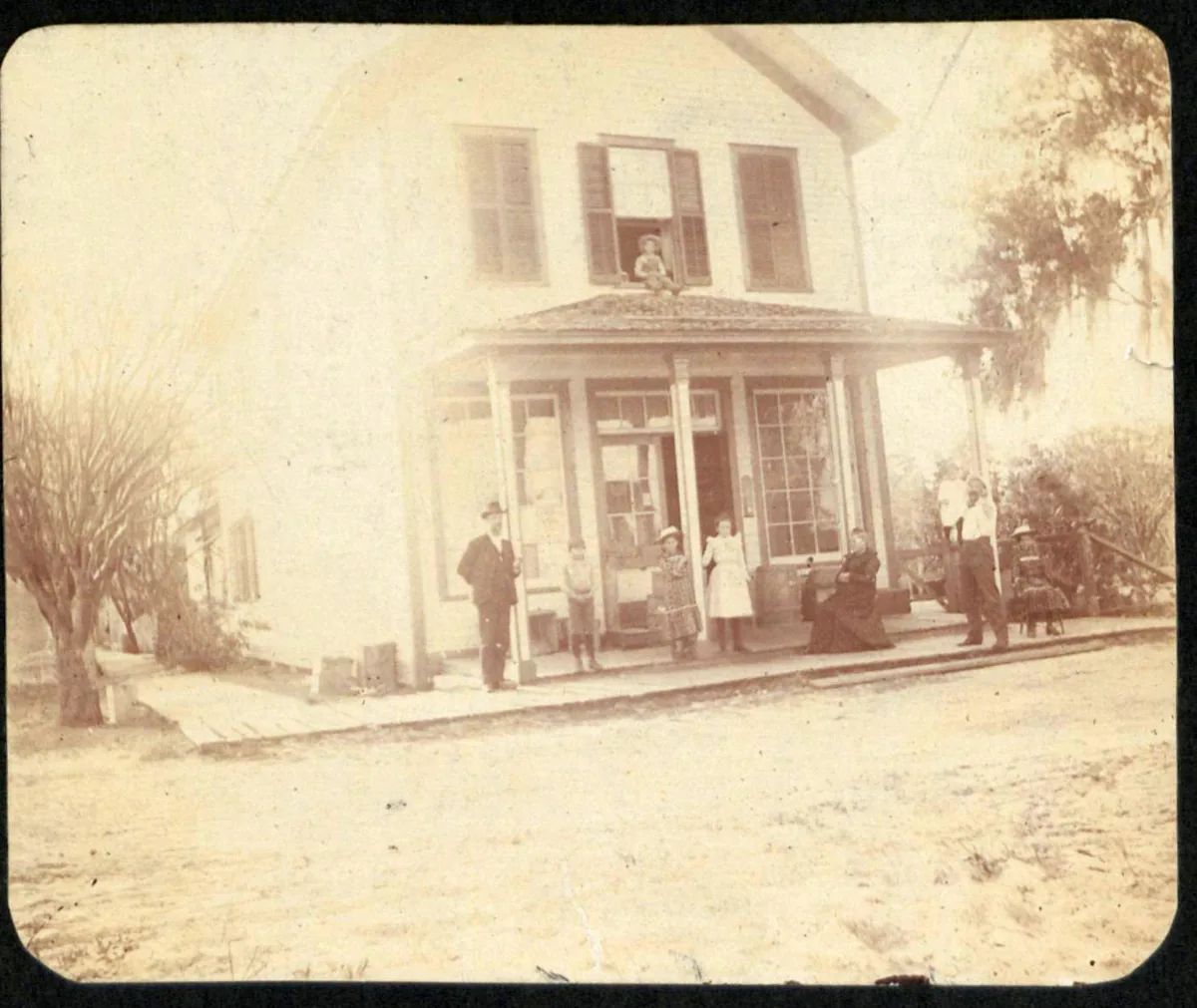
A two-story frame general store with a covered porch on a sand street, a German family in their Sunday clothes posed out front, a small child sitting in an upstairs window, Spanish moss hanging from a tree at the right.
The store at the middle of the colony
A German family on a Florida sand street. The Gotha general store with members of the Koehne family out front, circa 1903. Orange County Regional History Center, Koehne Family Collection.

Drive the west shore of Lake Butler today, down Lake Butler Boulevard past the big lots and the old oaks dripping moss, and it feels like money found this water first. It did not. The first people to go all in on this corner of the Butler Chain were a crowd of German freethinkers who followed a printer down from Buffalo, and the thing they built at the center of their town was not a church. It was a hall with a gym, a stage, and a bowling alley.

That hall is older than most of Central Florida’s churches. Which raises a fair question, standing on a lakefront lawn out here: who comes to raw Florida pine land in the 1880s and builds the bowling alley first?

The printer who mailed Florida to Germany

His name was Henry Hempel, and he made his living as a printer in Buffalo, New York. He had invented a little printing tool and patented it, which is a useful detail, because the man was about to run the whole state of Florida through a printing press.

An oval studio portrait of an older bearded man in wire-rimmed glasses and a dark coat, captioned Henry A. Hempel.
Henry A. Hempel
The founder. Henry A. Hempel, the Buffalo printer who laid out Gotha. Portrait from a period newspaper notice.

Hempel came to central Florida around 1879, liked what he saw, and kept buying until by 1883 he held roughly a thousand acres between what is now Ocoee and Windermere. He named the place Gotha, after the city he was born in back in Germany. Then he did the thing a printer would do. He wrote a pamphlet.

He called it On the Back Bone of Florida, and he mailed it to cities in the north and across the ocean to Germany. It is a sales pitch and a confession at the same time. In it Hempel says plainly that he did not lay out Gotha to flip it for a profit. He meant to live there, and he wanted to be surrounded by a certain kind of neighbor: families of what he called a progressive nature, people of a social disposition, the sort who form their own opinions.

A printed yellow promotional pamphlet reading On the Back Bone of Florida, Gotha, The New Colony in Orange County, Fla., with dense columns of text under headings like Origin of the Project and As an Investment, and the name H. A. Hempel at the bottom.
The pitch, mailed to Germany
Florida, run through a printing press. Hempel’s pamphlet On the Back Bone of Florida: Gotha, The New Colony in Orange County, Fla., printed in Buffalo. Orange County Regional History Center.

That last part is the whole story in a phrase. Hempel was a freethinker, which in the 1880s meant a specific thing: someone who trusted reason and evidence over authority and church doctrine. He was not building a congregation. He was recruiting a colony of people who thought the way he did, and he used a Florida orange grove as the bait.

And they came. German families answered the pamphlet, bought in, and spread out across the plat Hempel had drawn, a tidy grid of streets and lots laid over the pine with the lakes left open in the middle of it.

An 1885 surveyor's plat titled Map of Gotha, Orange Co., Florida, showing a grid of numbered streets and lettered blocks laid out around several named lakes including Olivia Lake and Lake Eugene, with Hempel's Grove and a mill marked.
The town, on paper, 1885
A grid drawn over the pines. The 1885 plat of Gotha, around Lake Olivia, the next water over from Lake Butler. Hempel’s own grove and mill are marked. Drawn by H. Chandler, Buffalo. Orange County Regional History Center.

What a colony of freethinkers actually built

If church was not the center of town, something had to be. For these Germans it was the Turnverein, an old-country society built around gymnastics, music, and plain argument. In 1887 about thirty of them put up Turner Hall, and that building did the work a church steeple does somewhere else. Meetings. Dances. Musical nights. Even a bowling alley by the 1890s. It was the room where the colony became a town.

A modest gable-fronted wooden hall half-hidden among trees on a sand road, a small round emblem set in the peak of the gable.
Turner Hall, the town’s real center
Where the steeple would have gone. Gotha’s Turner Hall, the Turnverein meeting house built in 1887 for gymnastics, music, and dances. Orange County Regional History Center.

The man who held it all together was Charles Koehne, out of Oldenburg, Germany, by way of a German colony in Minnesota and a picture-framing business in Indianapolis. He bought Hempel’s store and a piece of ground on one of the lakes, ran the shop, taught the calisthenics classes at the hall, and was remembered as the patriarch of the place.

A sheet of Gotha letterhead with an engraved bird's-eye view of the colony at the top, showing orange groves running down to a lake dotted with sailboats and labels for Lake Olivia, Turners Hall, and several villas, above a handwritten German list of the Koehne family's birthdays.
The family, logged by the weekday
Even the birthdays were kept in German. Koehne family letterhead, engraved with a view of the colony over Lake Olivia and a handwritten record of each child’s birthday and the day of the week it fell on. Orange County Regional History Center.

You can read the colony right off the Koehnes’ own stationery. The letterhead carries an engraved view of Gotha, groves running down to a lake full of sailboats, the villas and Turner Hall labeled along the bottom. Below it, in a careful German hand, somebody wrote out the whole family: Charles and Minna, then nine children, each name followed by the date and the day of the week they were born. These were people who kept records.

The letter that showed up sixty years later

Here is where it turns strange. The Indianapolis that Charles Koehne came out of was a hotbed of German freethinkers, and the first family of that world was named Vonnegut, as in Kurt Vonnegut, the novelist. His people ran the freethinker society and the German school in that city.

A handwritten letter in brown ink dated September 10, 1945, beginning Dear Misses Koehne and Brother George, signed at the bottom Your Franklin Vonnegut, recalling their father's involvement in the Turnverein.
Sept. 10, 1945
From the other famous freethinking family. Franklin Vonnegut writes the grown Koehne children in 1945, remembering their father in the life of the Turnverein. Orange County Regional History Center.

In 1945, long after Charles Koehne had died and his children had scattered, Franklin Vonnegut sat down in Indianapolis and wrote the Koehne kids a letter. He had dug up an old note among his papers, and it brought their father back to him: how Charles had taken the teenage Franklin under his wing at the Turner society, how he showed up Sunday mornings to give the young members encouragement. One German freethinking family, writing another, sixty years on, about a movement that reached from a hall in Indiana to a sand road in Orange County.

The winter that broke the bet

The oranges were supposed to pay for all of it. That was the pamphlet’s promise, a grove as an independent fortune. And for a few years the trees did fine.

Then came the winter of 1894 and 1895. The cold came down the peninsula in two blows, the first freezing the fruit and the second splitting the trees to the root, and the groves the northerners had planted around Gotha were dead wood by spring. For a colony sold on citrus, that was the floor dropping out. Some of the German families packed up and left Florida the way they had come.

The grove was the reason they were sold. The land was the reason they stayed.

What grew back

Because plenty of them did stay, and one of the people the empty, cheap, frozen-out land pulled in turned out to matter more than the oranges ever had.

An early-1900s frame house with a two-story porch set behind a lush garden, a tall martin birdhouse on a pole in the sandy yard, captioned Home of H. Nehrling, Gotha, Fla.
Nehrling’s cottage and garden
The garden that outlasted the grove. Horticulturist Henry Nehrling’s Palm Cottage Gardens in Gotha, early 1900s. State Archives of Florida, Florida Memory.

His name was Henry Nehrling, a naturalist who moved out to Gotha for good around 1902 and turned a piece of his land into one of Florida’s first great tropical gardens. He trialed thousands of plants on it and became the man who made the caladium, that big painted heart-shaped leaf, into a Florida crop. People rode the train out from Orlando just to walk his grounds. The grove failed; the garden made Gotha famous for something else entirely.

The same two-story white frame house today, with a double-decker porch, decorated with green garland and red bows, framed by tall bamboo and potted tropical plants.
The same house, still standing
Still here. Nehrling’s home at Palm Cottage Gardens in Gotha, present day, now Nehrling Gardens and on the National Register. Photograph via Wikimedia Commons (public domain).

The town eventually got its church too, a little Gothic one built in 1913, decades after the bowling alley. And if you want proof that Gotha stayed the kind of quiet, tree-shaded place where a person goes to spread out and be left alone, consider that the painter Bob Ross, the happy-little-trees man himself, is buried here under the real oaks.

The room was always the point

So go looking for the orange colony on the west side of the Butler Chain and you will not find it. The groves are gone, Turner Hall is gone, Hempel is a street name. What you find is Lake Butler Estates and the lanes around it: big lots, a lake at the bottom of the yard, oaks that took a century to get that tall.

A present-day boardwalk winding through grasses to a covered boathouse on a wide open Central Florida lake, a boat crossing in the distance, cypress and pines framing the view.
The lake is still the whole point
What never froze. The Butler Chain of Lakes off Lake Butler Boulevard near Windermere, present day. Photograph via a Windermere property listing.

The thing Hempel was actually selling was never the fruit. It was room, a piece of ground big enough that a family could land on it and build the life it wanted: a house, a grove, a store, a hall with a bowling alley in it. The oranges were just the first thing they tried putting on all that space. The space is what stayed.

And it is still what people buy out here. The grove is a memory and the colony is a historical marker, but the plain old Florida instinct underneath them, get a piece of ground with room on it and build what you need, is alive in every oversized lot on the west shore of Lake Butler.

A present-day note · Orange Tiny Homes

The room is still the asset. Now it grows a second little house out back.

A present-day Lake Butler backyard at sunset: a big moss-draped oak arching over a lawn and pool, the open lake glowing orange behind it.
Room out back, Lake Butler today

Every family Hempel recruited did the same plain thing: they took a piece of ground with space on it and built what their life actually needed, a grove, a cottage for a grove hand, a second little house for the relatives. The groves are gone. The instinct never left, and the room out back never went anywhere.

These days the useful thing people put on that room has a name, an ADU, an accessory dwelling unit, and it is what we build. A granny flat so a parent can live close with their own front door. A guest house. A rental cottage out back that helps carry the place. A tiny home in the far corner of the lot. Same instinct the Gotha families had, just with a kitchen, a bathroom, and a permit.

And you do not need Butler Chain acreage for it. The roomy lots around Windermere and Gotha, sure, but also ordinary yards in Conway, Pine Hills, Azalea Park, Winter Garden, and Meadow Woods, plenty of homes already have the space. What actually decides it comes down to your own address:

The real answer to “is there room out back for this?” is not a guess. It is a handful of facts about your lot, and that part we can check for you.

Put in your address and we will pull what your parcel allows and tell you whether a granny flat, guest house, rental, or tiny home actually fits, before you spend a dollar on drawings.

Start the ADU Fit Check→
Sources & Photo Credits

On the history

What is documented and what is nearby: Gotha’s 1885 town plat was drawn around Lake Olivia, the lake just west of Lake Butler; the German colony’s families settled across this corner of the Butler Chain, the same high ground the present-day Lake Butler Estates neighborhood later grew on. This page does not claim any specific Lake Butler Estates parcel was one of Hempel’s original town lots; it tells the documented history of the colony that settled this corner of the chain. The Vonnegut letter concerns the Indianapolis Turnverein that Charles Koehne belonged to, not Gotha itself; it is used to show the freethinker world the colonists came from. Full notes are in source-record.md beside this page.

Photographs

  1. Gotha general store, circa 1903 (hero): the store with members of the Koehne family out front; Orange County Regional History Center, Koehne Family Collection. File: gotha-general-store-c1903. thehistorycenter.org
  2. Henry A. Hempel: oval portrait of Gotha’s founder, from a period newspaper notice. File: henry-hempel-portrait. nehrlinggardens.org
  3. Hempel’s pamphlet: On the Back Bone of Florida: Gotha, The New Colony in Orange County, Fla., printed in Buffalo, New York; Orange County Regional History Center. File: hempel-pamphlet-front. thehistorycenter.org
  4. Map of Gotha, 1885: the surveyor’s plat of the colony around Lake Olivia, showing Hempel’s Grove and the mill; drawn by H. Chandler, Buffalo; Orange County Regional History Center. File: hempel-pamphlet-map. thehistorycenter.org
  5. Gotha Turner Hall: the Turnverein meeting hall built 1887; Orange County Regional History Center. File: gotha-turner-hall. thehistorycenter.org
  6. Koehne family letterhead: engraved view of Gotha over Lake Olivia with a handwritten German record of the family’s birthdays; Orange County Regional History Center. File: koehne-family-letterhead. thehistorycenter.org
  7. Franklin Vonnegut letter, 1945: letter to the Koehne children recalling their father in the Indianapolis Turnverein; Orange County Regional History Center. File: vonnegut-letter-1945. thehistorycenter.org
  8. Nehrling’s Palm Cottage Gardens, early 1900s: the home and garden of horticulturist Henry Nehrling in Gotha; State Archives of Florida, Florida Memory, via Wikimedia Commons (public domain). File: nehrling-home-greenhouse-gotha. commons.wikimedia.org
  9. Palm Cottage today: Nehrling’s house as it stands now, Nehrling Gardens, Gotha; photograph by Rnehrling, 2010; Wikimedia Commons (CC0 public domain). File: palm-cottage-gotha-2010. commons.wikimedia.org
  10. Butler Chain off Lake Butler Boulevard, present day: a boathouse and dock on the Butler Chain of Lakes near Windermere; via a Windermere property listing. File: lake-butler-blvd-dock-today.
  11. Lake Butler backyard, present day: an oak-shaded lakefront yard on the west shore of Lake Butler at sunset; from a listing for a home on Lake Butler Boulevard, Windermere. File: lake-butler-oak-backyard-today.

Original downloads and a full research record are kept alongside this page in assets/images/originals/ and source-record.md. No historical image was altered in any way that changes its content. The Polaroid frames and handwritten notes are CSS added around the images, never onto them. The two present-day lake photographs are of Lake Butler itself and are labeled as present-day.