Isleworth, Orlando, Florida  ·  A Local History

Before the Mansions, Isleworth Was the Orange That Didn’t Freeze


Most of Central Florida’s growers got wiped out in two winters and ran south. Two brothers looked at one stubborn patch of grove by the Windermere lakes, called it the Isle of Worth, and did the opposite — they went and bought more room.

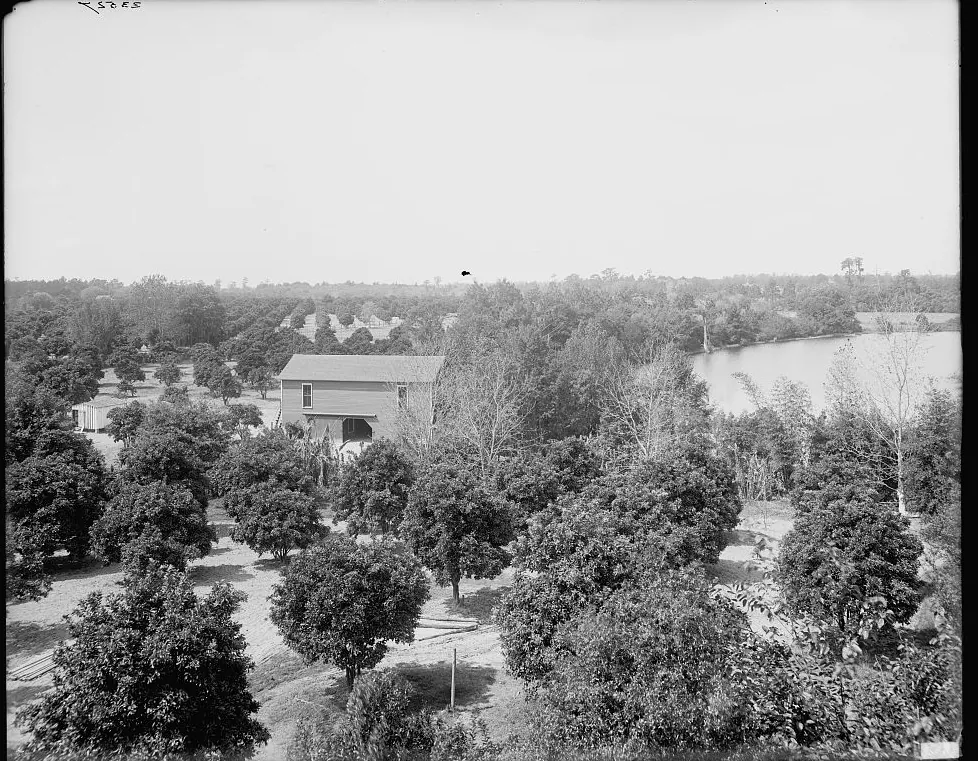
An elevated view across rows of orange trees to a lake on the right, a tall barn or packing shed in the middle distance and more groves stretching to the horizon.
Groves on the water, Orlando — about 1900
This is what the money was. Orange groves running down to a lake near Orlando, around 1900 — a packing shed in the trees, the water on the right, more grove all the way to the tree line. Detroit Publishing Co., Library of Congress. A representative Central Florida grove of the era.

Out past Windermere, tucked into the Butler Chain of Lakes, there’s a gate you don’t drive through unless you’re invited. Behind it is Isleworth — some of the most expensive houses in Florida, a golf course that’s eaten its share of famous names, the kind of place that shows up in tabloids more than history books. And the whole thing is named after an orange.

Not the golf. Not the lakes exactly. The name goes back to two brothers who grew citrus here, and who called this ground the “Isle of Worth” for one plain reason: the fruit didn’t die out here when it died nearly everywhere else. So how does a patch of frost-shy orange grove end up being the most valuable word in a billionaire’s address?

The two winters that ended an industry

To understand the “worth,” you have to understand what happened to everybody who didn’t have it. On the night after Christmas in 1894, the cold came down into Central Florida and killed the fruit on the trees. Growers figured they’d taken their hit and started over. Then in February it came back and killed the trees themselves. People later called it the Great Freeze, and it broke the back of the citrus business up here.

A bare, stripped orange grove on flat open ground after a hard freeze, trees without leaves or fruit, a crate sitting in the rows.
After the Big Freeze — 1895
What was left. A Central Florida orange grove stripped bare after the freeze, photographed in May 1895 — the trees that fed a family, standing dead in the spring. “Orange Grove at Citra, Fla. after the Big Freeze.” USDA National Agricultural Library, Special Collections.

The number that still gets quoted is the temperature drop — better than sixty degrees in a single day, warm shirtsleeve afternoon to hard killing freeze by the next morning. A grove is a slow bet. You plant the trees and wait the better part of a decade before they really pay you. Almost nobody had the cash to sit out those years twice, so the small growers were finished. Thousands of acres got walked away from. A lot of families left Florida for good, and a lot of the ones who stayed in citrus picked up and moved the whole operation south, chasing warmer ground down toward Polk County.

The brothers who bought instead of ran

Sydney Chase came down from Philadelphia to Sanford in 1878 — a young man learning the orange business from the ground up, working General Henry Sanford’s experimental groves at a place called Belair. His older brother Joshua joined him in 1884, and the two of them hung out a shingle: Chase & Company. They started the careful way, selling other growers the dull necessary things — fertilizer, fire insurance — and only later put their own money into their own trees.

A studio portrait of a middle-aged man with a full mustache in a formal suit and bow tie, looking off to one side.
Sydney O. Chase
The man who stayed. Sydney Octavius Chase (1860–1941), who came to Sanford at eighteen to learn citrus and, with his brother Joshua, built Chase & Company. University of Florida Digital Collections.

So when the freeze gutted everyone else, the Chases were exactly the sort of operation that could do the thing almost nobody else could: keep going, and go bigger. While wiped-out growers were selling their land for whatever they could get, the brothers were buying it. That’s the move the whole story turns on. A freeze that reads as a catastrophe to a man with one grove reads as a clearance sale to two men with capital and nerve.

An old sepia photograph mounted on a card showing workers inside a wooden citrus packing house, crates and sorting tables under a long open interior.
Inside the Chase & Co. packing house, Sanford
Where the fruit became a business. The Chase & Company packing house in Sanford, before the building burned and was rebuilt in 1908 — one of the town’s biggest employers in the early 1900s. Chase Collection, Special and Area Studies Collections, University of Florida.

The Isle of Worth

What they were buying, out by the lakes west of Orlando, was room — and a particular kind of room. By 1886 the brothers had put together a grove near Windermere that ran to around thirteen hundred acres, laid along the Butler Chain of Lakes. That’s the piece they called the Isle of Worth.

The name wasn’t poetry. Big water is a blanket. A grove ringed by deep lakes rides out a cold snap that flattens a grove sitting alone in open flatwoods, because all that water gives its heat back slowly through the night and keeps the air around the trees a few saving degrees warmer. Growers knew it, and they paid for it. Ground that kept its fruit through a freeze was worth more than ground that didn’t — a lot more, after 1895 made the difference life or death. An island of trees that held its oranges really was an isle of worth.

An 1890 map of Orange County, Florida, showing a grid of townships and sections, a scatter of lakes across the western half, and the surnames of landowners printed on their parcels.
Orange County, 1890 — the room, carved into parcels
The room, on paper. A map of Orange County from 1890, the same years the Chases were expanding — townships and sections, the chain of lakes scattered down the west side, and the names of the people who’d claimed their ground printed right on it. Fries & E. W. Smith & Co., Library of Congress.

Citrus was the point of nearly all of it. You set the trees, waited out the years, and then a good grove paid you back every winter — northern cities buried in snow and down here the fruit coming off the branch. The brothers kept at it for generations. Sydney built a cypress bungalow on Lake Louise in 1913; years later his son Frank came out to run things, and Frank and his wife Helen lived in that lake house until the 1980s. For most of a century, this was family citrus ground on the water.

A man near the top of a tall wooden ladder leaning into a big orange tree to pick fruit, with filled baskets of oranges on the ground below.
The payday crop
What the room grew. A grower up a ladder picking oranges, filled baskets below — a Florida grove around 1880. “Scenes in Florida,” W. H. Cushing, St. Augustine; via the New York Public Library. A representative grove of the era.
A studio-style photograph of three citrus workers standing with picking buckets and a crate, posed in front of a painted backdrop.
The hands that brought it in
Somebody picked every orange. Three citrus workers with their buckets, Central Florida, around 1890 — a grove was only worth what crews like this could get off the trees and into the crates. RICHES of Central Florida, University of Central Florida.

Room was the whole game

Here’s the part that outlasted the citrus. The Chase move — get a piece of ground with room on it, and put the thing you want out there yourself — wasn’t some rich-man’s trick. That was just how this corner of Florida got built, up and down the scale.

Before the groves and alongside them, this was open country. Cattle ran loose across unfenced miles of pine and palmetto; a man’s wealth was partly how much room his herd could wander. Families came down, claimed their acres, and built a little at a time — a house, then a barn, then a packing shed, then a second small place out back when more family turned up. Nobody finished a homestead in a season. You added on as life asked you to, because the room was sitting there to add onto.

An 1895 illustration of a Florida cow hunter on horseback with a dog beside him, cabbage palms behind, in open scrub country.
Open range, same year as the freeze
Before the fences. A Florida “cracker” cow hunter, drawn by Frederic Remington for his 1895 piece on the state’s open-range cattlemen — the same winter the Great Freeze was finishing the groves a little to the north. Harper’s, 1895; via Wikimedia Commons.

And the names out here tell on themselves. Windermere, just up the road, was platted in 1887 by an Englishman who named it after a lake back home in England’s Lake District. The whole area is people who found a piece of Florida with water and room and decided to make it theirs. The Chases just did it at grove scale, and gave their piece a name that happened to stick.

A color postcard view titled An Orange Grove in Florida, showing rows of orange trees heavy with fruit running down toward water.
“An orange grove in Florida”
How the rest of the country pictured it. A vintage Florida postcard of an orange grove by the water — the image that sold the North on the place. A representative Central Florida scene.

From groves to gates

The citrus didn’t last forever, even out here. More hard freezes came through in the decades after the war — the late 1940s, the late 1950s — and each one chipped at the groves. By the 1960s and ’70s the economics had shifted, and lakefront grove land near a growing Orlando was starting to be worth more with houses on it than with trees. The old Isle of Worth was ground waiting for its next use.

It came from the air. In 1984 Arnold Palmer flew over the Chase lands by the Butler Chain, saw the lakes and the room, and bought it to build a golf course with a community wrapped around it. The descendants sold; the grove became the gate. The name they kept — Isleworth — is the brothers’ old word for the same simple thing the golfers are paying for now. Good ground, by the water, with room.

What’s still out there

The trees are mostly gone. The lakes are not. The Butler Chain is still here, still clear, still the reason anyone wanted this spot in the first place — the same big water that once kept a grove from freezing now keeps the view from a back lawn.

A present-day view of a calm Butler Chain lake at Windermere, tall palms and shade trees along a grassy shoreline with a bench and a small historical marker.
The Butler Chain today, Windermere
The thing that never moved. A Butler Chain lake at Windermere today — the open water that made this ground an “isle of worth” in the first place. Present-day photograph, via Wikimedia Commons.

Two brothers came to the flat middle of Florida, found a piece of ground where the oranges didn’t die, and answered the worst winter anyone could remember by getting more of it. A hundred and some years later the fruit is gone and the name is on a guardhouse — but the thing it was pointing at the whole time, the room by the water, never went anywhere.

A present-day note · Orange Tiny Homes

The room was always the point.

Strip the gates and the golf off of Isleworth and you’re left with the oldest Central-Florida idea there is: get a piece of ground with room on it, and build the thing you actually want out there. The Chases did it with groves. The homesteaders around them did it a barn and a back cottage at a time. The room was never decoration — it was what let people put up what they needed, when they needed it.

That instinct still pays, and the thing people build out back now has a name — an ADU, an accessory dwelling unit. That’s what we do. A granny flat so a parent can live close with their own front door. A guest house. A rental out back that helps carry the mortgage. A tiny home in the far corner of the lot. The Chase move, basically — put what you want on the room you’ve got — just with a kitchen, a bathroom, and a permit.

And you don’t need thirteen hundred acres to do it. All across the greater Orlando area — the roomier lots out toward Windermere and the lakes, sure, but plenty of ordinary yards in Conway, Gotha, Pine Hills and unincorporated Orange County too — the space is already there. What actually decides it comes down to your own address:

The real answer to “is there room out back for this?” isn’t a guess — it’s a handful of facts about your lot. That part we can check for you.

Put in your address and we’ll pull what your parcel allows and tell you whether a granny flat, guest house, rental, or tiny home actually fits — before you spend a dollar on drawings.

Start the ADU Fit Check→
Sources & Photo Credits

On the history

Where sources differ: the local-history account traces “Isleworth” to the Chase family’s own “Isle of Worth” for their frost-shy grove; a separate popular claim links the name to Isleworth near London, England. This page uses the family’s own phrase, which is the better-documented origin, and notes the English theory here. The “sixty-plus degrees in a day” figure describes the broader Great Freeze across Central Florida, not a reading taken at Isleworth itself; no record claims the Isleworth grove came through 1895 untouched, only that the Chases kept operating and expanding when most growers did not. Later ownership is also reported variously (the Tavistock Group per Wikipedia; Aviva Land Holdings per one local-history page) — a detail past this story’s window. The Chase home is placed on “Lake Louise” per the local-history account. Full notes are in source-record.md beside this page.

Photographs & documents

  1. Orange groves on a lake near Orlando (hero) — an elevated view of orange groves running down to Lake Concord, Orlando, Florida, circa 1900. Detroit Publishing Co., Library of Congress Prints & Photographs Division. A representative Central Florida grove-on-the-water of the era. File: orange-groves-lake-concord-orlando-c1900. loc.gov/item/2016809289
  2. Orange grove after the Big Freeze, 1895 — a stripped, dead grove photographed after the freeze, “Orange Grove at Citra, Fla. after the Big Freeze, May 23, 1895.” USDA National Agricultural Library, Special Collections. A representative Central Florida freeze scene. File: citra-orange-grove-after-big-freeze-1895. nal.usda.gov
  3. Sydney Octavius Chase — a studio portrait of Sydney O. Chase (1860–1941), co-founder of Chase & Company. University of Florida Digital Collections, via the UF Libraries Ingraham Expedition page. File: sydney-o-chase-portrait. uflib.ufl.edu
  4. Chase & Company packing house, Sanford — workers inside the Chase & Company packing house in Sanford, Florida, before the building burned (rebuilt 1908). Chase Collection, Special and Area Studies Collections, George A. Smathers Libraries, University of Florida; via RICHES of Central Florida. File: chase-co-sanford-packing-house-c1890. richesmi.cah.ucf.edu/omeka/items/show/1569
  5. Map of Orange County, Florida, 1890 — a map showing townships, sections, lakes, and landowners’ names, drawn by J. O. Fries and published by E. W. Smith & Co., Philadelphia, 1890. Library of Congress Geography & Map Division, via Wikimedia Commons. File: map-orange-county-florida-1890. loc.gov/item/2012592407
  6. Picking oranges — a grower up a ladder picking oranges with filled baskets below, stereoview cropped to one frame, circa 1880. “Scenes in Florida,” W. H. Cushing, St. Augustine; New York Public Library, via Wikimedia Commons. A representative Florida grove of the era. File: picking-oranges-grove-c1880. commons.wikimedia.org
  7. Three citrus workers — three Central Florida citrus workers with picking buckets, circa 1890. RICHES of Central Florida, University of Central Florida (Origins of the Celery City). A representative citrus-labor scene of the era. File: three-citrus-workers-c1890. richesmi.cah.ucf.edu
  8. A Florida “cracker” cowboy — a Florida open-range cow hunter on horseback, drawn by Frederic Remington for “Cracker Cowboys of Florida,” Harper’s, August 1895. Via Wikimedia Commons. File: cracker-cowboy-remington-1895. commons.wikimedia.org
  9. “An Orange Grove in Florida” — a vintage color postcard of a Florida orange grove by the water. Via Wikimedia Commons. A representative Central Florida grove scene, undated. File: florida-orange-grove-c1890. commons.wikimedia.org
  10. The Butler Chain today — a present-day photograph of a Butler Chain lake at Windermere (Lake Down Park). Via Wikimedia Commons. Clearly a modern image. File: lake-down-butler-chain-windermere-present-day. commons.wikimedia.org

Original downloads and the full research record are kept alongside this page in assets/images/originals/ and source-record.md. Several images are genuine photographs of the right era and region used to show what Isleworth’s groves, freeze, workers, and lakes looked like; each is labeled above as specific to its subject or as representative. No historical image was altered in a way that changes its content; the picking-oranges stereoview was cropped to a single frame, the Orange County map and the hero were cropped at the edges and downscaled, and the Polaroid frames and handwritten notes are CSS added around the images, never onto them.