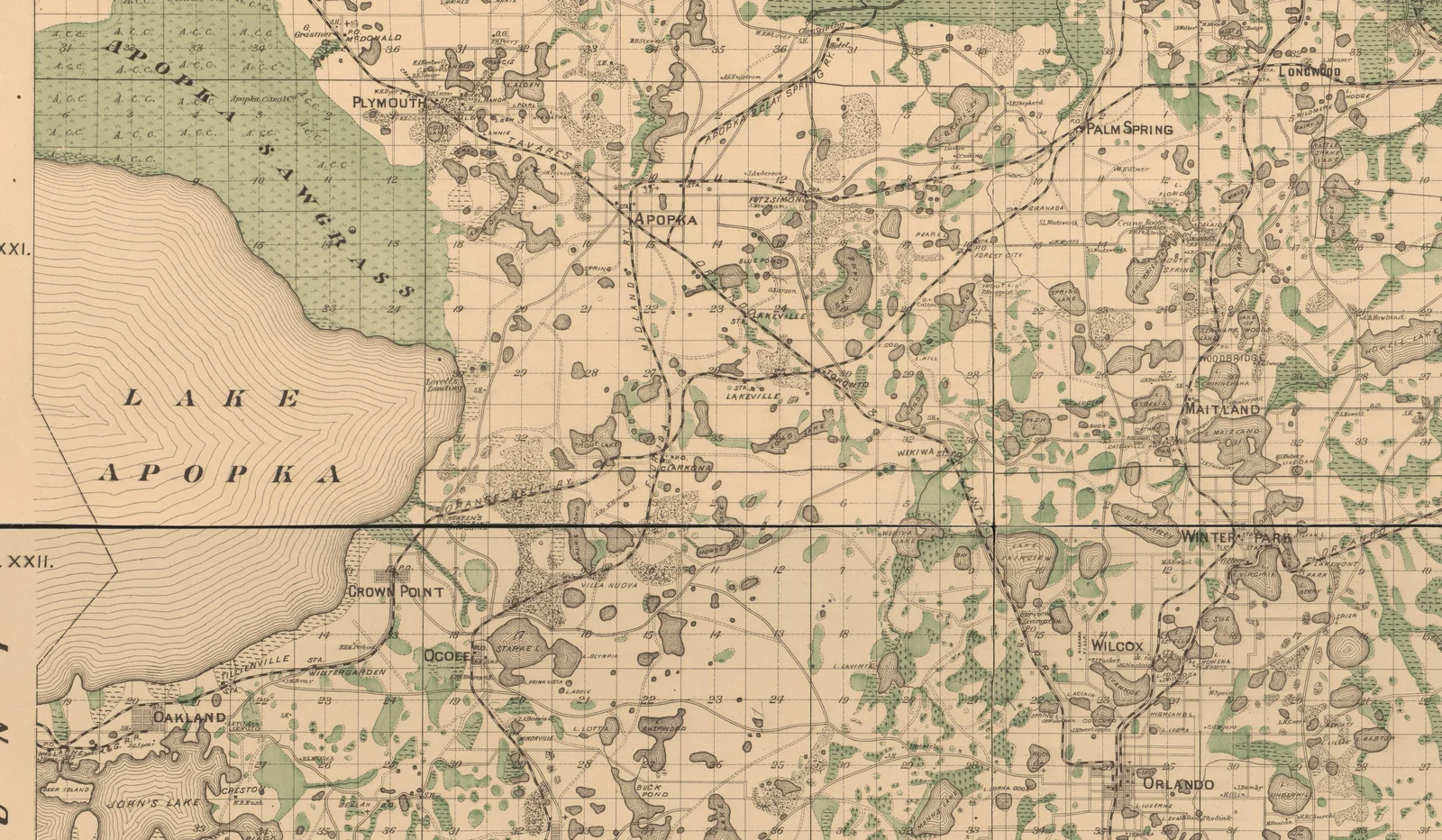
Drive out to Clarcona today and the first thing you notice is how much air there is. Board fences instead of privacy walls. A horse standing in a field that would hold forty townhouses. Nurseries, pastures, a few groves hanging on, lots measured in acres instead of feet. It feels like the kind of place where nothing much ever happened, which is the funny part, because a hundred and thirty years ago this quiet corner had two railroads, a packinghouse, a sawmill, a church with a steeple — and a three-story hotel.
A hotel. Out here. You can stand at the crossroads now and not find a single building tall enough to need a second flight of stairs. So where did a town like that come from, and where did it go?
The people the North wore out
It starts with dirt that stopped working — up north, not here. By the 1870s a lot of farms in New Hampshire and Connecticut and Massachusetts were simply tired. Generations of the same crops had pulled the life out of the soil, and the families on it started reading advertisements about a warm place down south where the land was cheap and, in a lot of cases, there for the claiming.

So they came. The first to stake out this particular patch was a man named Nathaniel Barlow, who homesteaded a hundred and sixty acres of pine and wiregrass. Right behind him, in 1880, came W. N. Clark, who put up a sawmill that grew into the biggest thing around. People started calling the spot Clark’s Corner.
There was already another Clark’s Corner with a post office over by DeLand, though, so when this one got its own post office in 1887 the name had to bend to fit. Clark’s Corner, squeezed together, came out Clarcona. The town was named, basically, after the man with the saw.
What they built out of nothing
And then they built like people who meant to stay. A Congregational church, the kind the New England crowd would have felt at home in. A school. A store. A packinghouse to box fruit. Clark’s sawmill cutting the lumber for all of it, and a turpentine still working the pine sap on the side.
Two railroads found the place — the Orange Belt and the Florida Midland — which for a settlement this size was a little absurd, like two interstates meeting at a farm stand. And then, the flourish: a three-story hotel, because every pinewoods crossroads in 1880s Florida was dead certain it was about to become the next great winter resort.

The whole bet rested on one crop, and you could smell it from the porch of that hotel. Oranges.
The money was supposed to grow on trees
This was citrus country before it was anything else, and the logic was hard to argue with. The land was warm and cheap and flat. The railroads could carry fruit north to people who’d never seen an orange still attached to a branch. Plant a few acres of trees, wait, and watch your money ripen in the sun.

For a few good years it did exactly that. The groves came in, the fruit went out on the cars, and a man could stand in Clarcona and believe he’d gotten in early on the next big thing. The hotel had guests. The church had a congregation. The whole gamble was paying.
Then two winters in a row reached down the peninsula and settled the argument.
The two nights that erased it
The freezes of 1894 and 1895 are the ones Florida growers still bring up a century later, and they hit the west side of Orange County about as hard as anywhere. A grove doesn’t just drop its fruit in a freeze like that. The trees themselves split and blacken and die standing up, years of patience gone in a couple of cold nights.

That was the end of the plan. All across west Orange County the little grove colonies emptied out, and Clarcona went with them. The hotel guests stopped coming. The packinghouse had nothing to pack. Families who’d crossed half the country to get here loaded up again. Even the lakes seemed to give up — Long, Alpharetta, Arlie, Trout, and one called Cora Lee all slowly dried down to grass and memory.
The town was a bet on a crop. When the crop died, the town went with it — everything except the ground it stood on.
The one thing a freeze can’t kill
Here’s the thing about a place built on open land: when the reason for the land disappears, the land is still there. The hotel could close and the railroads could quit and the groves could turn to firewood, and all of it did — but the acres stayed exactly where the New Englanders had claimed them. Flat, warm, and roomy.

So people kept coming — not for the boomtown, which was gone, but for the room. A family that wanted a few acres and some quiet could have both. You could keep a cow, a horse, a grove, a garden, a second little house for your mother, and still not see your nearest neighbor through the trees. The railroads had promised a fortune and failed. The land just quietly kept its one promise, which was space.
Horse country now
Look at what that corner between Pine Hills, Ocoee, and Apopka turned into and it reads like a town that decided, finally, to stop chasing. Not groves and grand hotels — pastures, plant nurseries, and horse farms. Board fences and barns. People who moved out this way on purpose, for the elbow room the citrus men left behind.

There’s a nice echo in how Clarcona defended that. Back in the 1960s the county tried to put a dump out here, and the neighbors organized and fought it off, and the ground that would’ve been a landfill became a forty-acre horse park instead — trails, show rings, room to ride. A place that had already lost one future to save still knew what its land was worth.

The hotel is a hundred years gone. The railroads are a couple of faded lines on a surveyor’s map. But stand at that crossroads and the thing the New Englanders actually came for — more land than the house in front of you strictly needs — is still sitting right there, behind the fences, waiting to be useful again.

