Bellaria · Lake Burden, Orlando, Florida  ·  A Local History

The Grove Froze. So the Growers Drew a Town.


The land under Bellaria was orange country, then a dead grove nobody could sell. What the trapped growers did next turned southwest Orange County into one of the most-planned corners of Florida, and kept its wide-open bones.

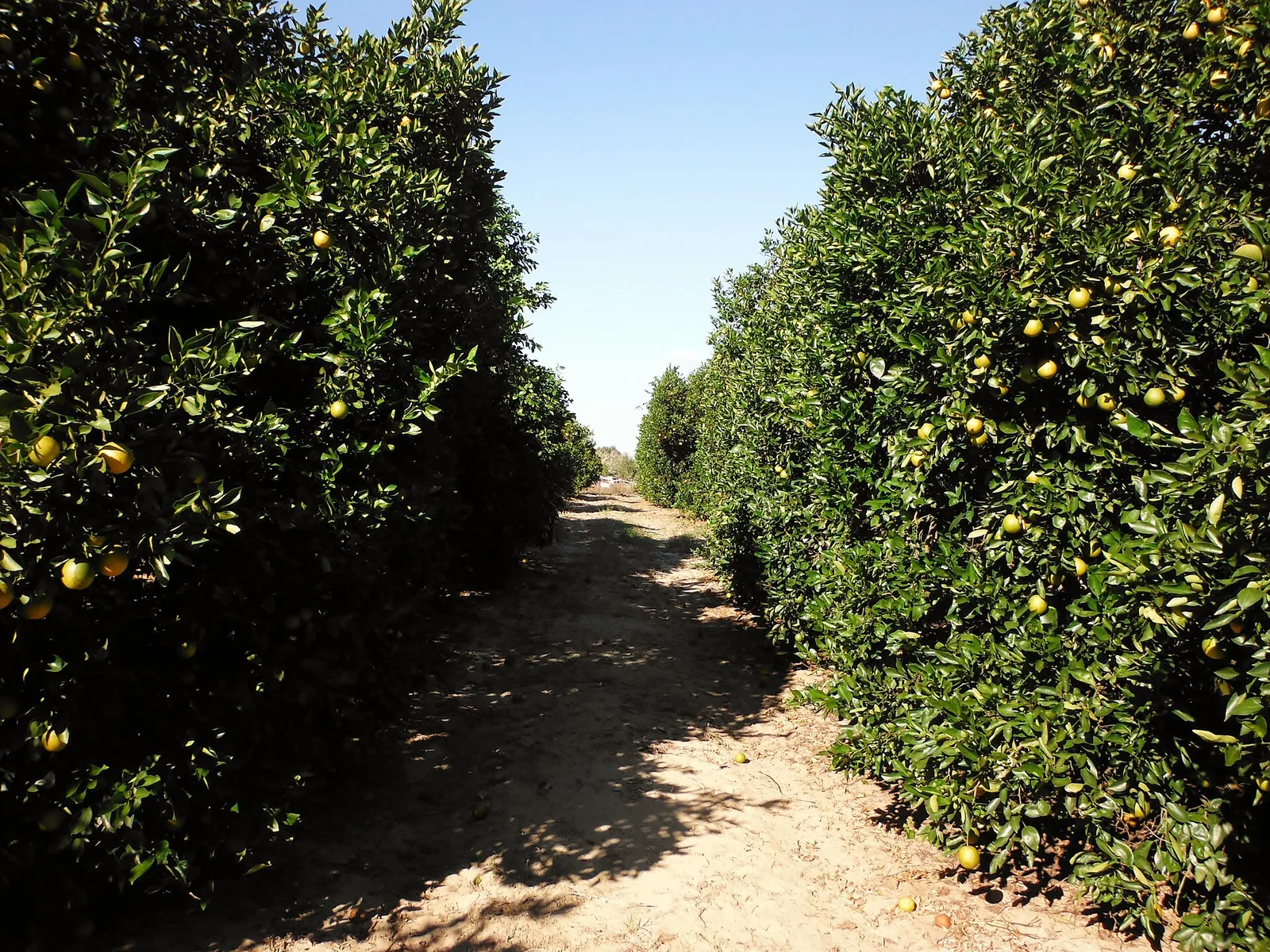
Long straight rows of mature orange trees heavy with fruit running back toward a treeline under a Florida sky, a sandy lane between the rows.
Orange country, southwest Orange County
A Florida orange grove in full fruit, rows running to the horizon, the kind of ground that covered the southwest corner of Orange County for a hundred years before any gate went up. Photograph via Wikimedia Commons.

There’s a guard gate out on West Lake Butler Road, and behind it sits Bellaria: big Mediterranean houses on lots that run from a half-acre to better than an acre, most of them looking out at Lake Burden. It is about as planned as a place can be, a guarded entrance, a review board, rules about what you can build and how it has to look.

Which makes the ground underneath it kind of funny. Because the reason all that planning exists is that, not very long ago, this exact corner of Orange County was a grove nobody could sell.

So how does one of the most carefully drawn pieces of southwest Orange start life as a dead orchard? That’s the whole story, and it runs back through oranges, cattle, and one very stubborn winter.

First it was grove and cattle

Drop back a few decades and the land out here looked like most of the high, sandy country west of Orlando: citrus on the good ridges, cattle on everything else.

A vintage color print of orange groves near Orlando, Florida, rows of fruit-laden trees with a few figures among them.
Orange groves near Orlando
“Orange Groves in Orlando, Florida,” an early printed view of the industry that named the county. Southwest Orange was planted in trees like these. Via Wikimedia Commons.

The oranges got the attention, Orange County didn’t get that name by accident, but the cattle were older. Long before the fence laws, cow hunters ran half-wild herds through the palmetto and scrub on open range, the animals wearing nobody’s brand until somebody rounded them up. An artist came through central Florida in the 1890s and sketched them for a magazine, and the name he used stuck: cracker cowboys.

A late-1800s illustration of a mounted Florida cow hunter in a broad hat sitting his horse under cabbage palms, a dog beside him.
A Florida cow hunter · 1890s
“A Cracker Cowboy,” Frederic Remington’s 1895 drawing of a central-Florida cattleman on the open range. Herds like his moved across the same scrub that later grew houses. Via Wikimedia Commons.

Groves and cattle have one thing in common: both of them need room, and lots of it. You don’t run cows or grow a few thousand trees on a quarter-acre. So the people who settled this country settled it spread out, one family holding a big piece of ground, neighbors a good walk away.

You built what you needed, out back

And once you’ve got that much land, you don’t build one house and call it done. You build what the place needs, a piece at a time.

A white wood-frame Florida farmhouse with a deep wraparound porch and tin roof, standing alone on a grassy clearing under oaks.
The main house
An old Florida “cracker” farmhouse, wood frame, deep porch, metal roof, built for the heat before anyone had air conditioning. The house was only the start of what sat on a homestead. A representative Florida home; via an online photo source.

There was the main house. A barn. A shed to grade and pack the fruit. A smokehouse, a well house, a pen. And very often a second small place out back, a cabin for the grown son who worked the grove, or a room for the hands who came through at picking time.

A small weathered unpainted wood cabin raised on low piers, standing under large live oaks on a rural Florida homestead.
The second place out back
A small outbuilding cabin on a Florida homestead, raised off the ground under the oaks, the kind of extra dwelling a grove family put up for kin or grove hands. A representative example; via an online photo source.

Nobody thought twice about it. A lot wasn’t a slot for a single house, it was ground you kept adding to as the family grew and the work demanded. The habit of putting up a second small home out back is older out here than the subdivisions that eventually paved over it.

Then the cold came and stayed

The catch with oranges in central Florida is the one that caught everyone: every so often the cold slides far enough south to kill the trees. Most winters it doesn’t. Then a winter does.

Oranges still on the branch completely sheathed in thick clear ice after a hard freeze, long icicles hanging from the frozen fruit and leaves.
When the grove freezes
Oranges sealed in ice after a hard Florida freeze. Growers spray the trees because a coat of ice can hold the fruit at freezing instead of colder, but through the 1980s the cold kept winning. Photograph via Orlando Sentinel / news archive.

The 1980s were a run of those winters, one after another. Growers would lose a crop, replant, and lose it again. The one people out here still name is the freeze that came over Christmas weekend in 1989, a cold so hard it finished what the earlier freezes had started. After that, the big commercial citrus packed up and chased the warm winters south, and the groves of southwest Orange went quiet for good.

Frozen out, then fenced in

Here’s where it gets strange. A dead grove is still land, and land is usually still worth something. But right as the growers hit bottom, the county drew a line that took even that away.

In 1991, trying to keep the southwest corner from sprawling into a mess of strip malls, county planners zoned this whole rural wedge for agriculture only. On paper it made sense. On the ground it meant a grower with no oranges left couldn’t grow anything that paid, and couldn’t sell the land to anyone who wanted to build, either. No fruit, no buyer. Just acres of frozen trees and a tax bill.

They couldn’t sell the land. So they decided to plan it.

So they drew a town

In November of 1992, the growers and a few land people sat down together at a restaurant out on the highway called the Ranch House and started asking a different question. Not “who’ll buy my dead grove,” but “what if we stop selling it piece by piece and plan the whole thing at once.”

What came out of that room, and the years of meetings after it, was Horizon West. The families pooled their land, working with the county instead of fighting it, and drew up not a subdivision but a town: a set of walkable villages, each with its own center and schools and parks, wrapped around the lakes. The county signed off on the framework in 1995. It was the first plan of its kind the state of Florida ever approved.

An aerial view of present-day Horizon West near Winter Garden: village streets, a town center with shops, ponds and new neighborhoods spread across land that was citrus groves.
The groves, replanned (now)
Horizon West today, near Winter Garden. Villages, a town center, and schools now cover what was nearly 23,000 acres of frozen grove, a dead orchard the size of a small city, redrawn as a town. Present-day photograph via Orange Observer / news archive.

The first village, Lakeside, broke ground in the late 1990s, and the rest followed over the next twenty-odd years. Bellaria, built out in the years around 2010 on the shore of Lake Burden, sits right at the edge of all of it, one of the gated pieces that filled in as the old grove land became neighborhoods.

What the freeze couldn’t take

Lose the trees and you lose the crop. You don’t lose the shape of the land.

Low citrus-country land running down to a wide calm Florida lake under a pale sky, scattered trees along the far shore.
Grove country runs to the water
Central Florida grove land sloping down to a lake. The lakes and sandy ridges that made the citrus country are exactly what the new villages were drawn around. A representative view; via Wikimedia Commons.

The lakes stayed. The ridges stayed. And the thing the whole place had been carved into, one family, a big piece of ground, room to build more than one thing on it, was already pressed into the map before a single villa went up. The growers who planned Horizon West weren’t starting from a blank sheet. They were working with parcels that had always been measured out generously, because groves and cattle had needed them that way.

An aerial view of large wooded estate homesites along a Windermere-area lakeshore today, big houses set far apart among mature trees.
Room, kept (now)
Big lakefront lots in the Windermere area today. The generous spacing isn’t a modern luxury invented from nothing, it’s the grove-and-cattle scale the land was always held at. Present-day photograph via a real-estate / aerial source.

So Bellaria’s half-acre-and-up lots along Lake Burden aren’t a new idea. They’re the oldest idea out here, dressed in stucco and a gate: enough ground around a house to build a whole life on, not just a bedroom and a lawn.

A wide aerial panorama of the lakes and wooded neighborhoods of the Windermere and Butler Chain area at golden hour, water threading between green peninsulas of homes.
Southwest Orange, from the air (now)
The lake country of southwest Orange County today, the water the groves once ran down to, now threaded with the villages the growers drew. Present-day photograph via a real-estate / aerial source.

That guard gate on West Lake Butler Road makes Bellaria look like the most planned thing for miles. In a way it is. But the room it’s guarding was there long before the plan, it belonged to a grove, and the grove got it from cattle, and all of them kept it for the same plain reason: out here, you were always meant to have space out back for whatever came next.

A present-day note · Orange Tiny Homes

The space out back was always the point.

The grove families never saw a lot as a spot for one building. It was ground you added to, a packing shed, a barn, a little cabin out back for the son or the hands. Horizon West got drawn on that habit, and a big lot behind a gate like Bellaria’s still carries it.

Today the second building out back has a name. It’s an ADU, an accessory dwelling unit, and it’s what we build. A granny flat so a parent can live close but on their own. A guest house. A rental out back that helps carry the mortgage. A tiny home on the far corner of the lot. The same move the grove families made, now with a kitchen, a bathroom, and a permit.

And you don’t need a Lake Burden acre for it. All across greater Orlando and Orange County, the roomy lots out this way, sure, but also plenty of ordinary yards in Winter Garden, Ocoee, Gotha, and Meadow Woods, the space is already there. What actually decides it is specific to your address:

The real answer to “is there room out back for this?” isn’t a guess, it’s a handful of facts about your lot. That part we can check for you.

Put in your address and we’ll pull what your parcel allows and tell you whether a granny flat, guest house, rental, or tiny home actually fits, before you spend a dollar on drawings.

Start the ADU Fit Check→
Sources & Photo Credits

On the history

A note on numbers and names

Photographs & documents

  1. Florida orange grove in full fruit (hero), rows of fruited orange trees; via Wikimedia Commons. A representative Florida grove, not a Bellaria location. File: grove-sea-fl. Commons
  2. “Orange Groves in Orlando, Florida”, early printed view of the Orlando-area citrus industry; via Wikimedia Commons. File: orange-groves-orlando. Commons
  3. “A Cracker Cowboy”, Frederic Remington, 1895; a central-Florida open-range cattleman; public domain, via Wikimedia Commons. File: cracker-cowboy-remington-1895. Commons
  4. Florida “cracker” farmhouse, a wood-frame house with wraparound porch; a representative historic Florida home, found via web image search (Pinterest copy). File: florida-farmhouse-porch. Source: i.pinimg.com/…/ec9bb2dd43caaefa6df4d5f8823c7243.jpg
  5. Small homestead outbuilding / cabin under live oaks; a representative Florida example of a second dwelling on a rural tract, found via web image search (Pinterest copy). File: florida-homestead-cabin. Source: i.pinimg.com/…/0e4140baffae750c79635568371428e5.jpg
  6. Oranges sealed in ice after a hard freeze; Florida citrus during a freeze. Representative of the 1980s freezes that ended southwest Orange’s citrus. Source: Orlando Sentinel photo archive. File: grove-freeze-ice. orlandosentinel.com (image)
  7. Horizon West today, near Winter Garden, present-day aerial of the villages and town center built on former grove land. Source: Orange Observer (Observer Media Group) photo archive. File: horizon-west-aerial-now. observermediagroup.media (image)
  8. Grove land running down to a lake, central Florida; a representative view of the citrus-and-lake landscape, via Wikimedia Commons. File: grove-and-lake-polk. Commons
  9. Large lakefront estate lots, Windermere area, present day; big wooded homesites set far apart. Source: real-estate listing media. File: estate-lots-lake-now. unitedmls listing media (image)
  10. The Butler Chain / Windermere lake country, present day, aerial panorama of the lakes and neighborhoods of southwest Orange County. Source: Realty in Orlando. File: butler-chain-aerial-now. realtyinorlando.com (image)

Original downloads and a full research record are kept alongside this page in assets/images/originals/ and source-record.md. Present-day photographs are labeled (now). No historical image was factually altered; the Polaroid frames and handwritten notes are CSS added around the photographs, never onto them. Images are sourced as the best available depiction of each real subject; where an image is representative of Florida grove, cattle, or homestead life rather than the Bellaria site itself, the caption says so.