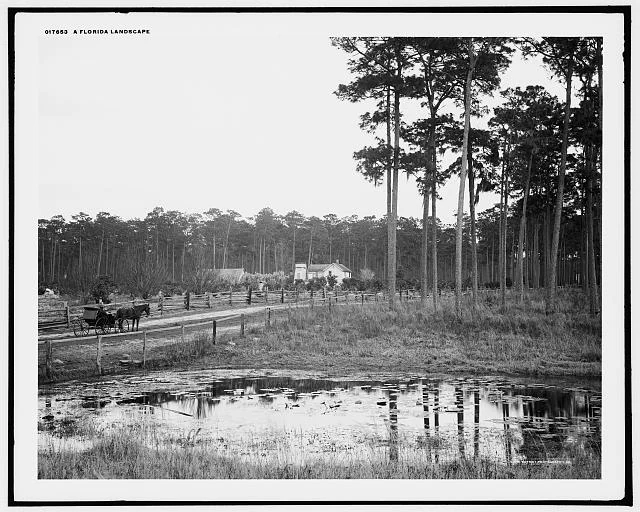
The settlers who cleared this corner of Lake County kept a standing appointment. One day a week, the men went out together to hunt bear. Not for sport — bears and panthers and foxes were working their way through the hogs and calves, and a weekly hunt was just part of keeping a farm alive out here.
That is the kind of place Astatula was at the start: close enough to the wild that you set aside time to shoot your way back from it. Which makes the obvious question a good one. Who looks at country like that and decides to build a town — and why did this one last when so many flashier ones didn’t?
The lake came with a pretty name and a hard job
Start with the water, because the water is where the name came from. Astatula sits on the east shore of a wide, bright lake the early maps called Lake Astatula. Today it’s Little Lake Harris, one link in the chain of lakes that runs up toward Tavares, Eustis, and Leesburg. The old word is said to mean something like sparkling waters, or the lake of sunbeams. Whoever did the naming clearly liked the view.

What they were standing on to admire it was another matter: flat pine woods, palmetto, and sand. Not much to look at, and not much to farm until you cleared it. But there was a great deal of it, and it was cheap, and that turned out to count for more than scenery ever could.
One family, five ways of making a living
The first to take it on were T. A. and Mary Hux, who settled here in 1872 on ground they got from a man named Colonel John Bryan. And here’s the part worth slowing down on: they didn’t plant one thing and wait. They put in cotton. Sugarcane. Oranges. They grew corn — not only to eat, but to sell to the crews laying railroad track through the lake country.

And Hux ran cattle. He drove his herds clear down to Tampa, where they were loaded onto boats bound for Cuba. So picture it: one family, one piece of land, and about five different ways of pulling a living out of it at the same time — a cotton patch, a cane field, a grove, a corn crop, and a herd of range cattle headed for the coast.

You don’t do all that on a town lot
None of it happens without room — room to let the cattle range, room to set a cane patch beside a grove beside a corn field, room to add whatever the next year seemed to call for. That was the Florida habit out here. You didn’t build a finished place. You built onto one: a cabin, then a barn, then a pen, then a shed, a little further out each time.

When the settlement needed somewhere to bury its dead, the Huxes cut a piece off their own land and gave it over for a cemetery. When the children needed teaching, up went a schoolhouse — sixteen feet by twenty, with benches the men hewed out of logs. The town didn’t arrive one day, finished. It got added on, acre by acre, out of ground nobody was short of.
Everything moved by water first
The hard part, the same as everywhere in inland Florida then, was getting anything out. Before the railroads stitched the lake country together, the lakes themselves were the highway — freight and passengers came down the St. Johns River by steamboat and transferred inland toward the lakes at Eustis, Dora, and Harris.

That’s the world Hux’s corn was feeding — the crews building the narrow-gauge lines that would finally give the lake country a dry way to ship its fruit and cattle north. On the maps of the 1880s you can watch it happen: the little rail lines creeping down from Ocala and Sanford, threading past Leesburg and Tavares and the string of bright lakes that Astatula sat on.

The schoolteacher who ran the Army
Which brings us back to that schoolhouse, and the strangest thing ever to come out of it. In 1885 a young man fresh out of a South Carolina military academy took the teaching job here — eighteen years old, standing in front of those hewn log benches in a sixteen-by-twenty-foot room in the pine woods. His name was Charles Summerall.

He taught at Astatula and over in Leesburg, saved what he could, and went off to West Point. Forty years later that same man was Chief of Staff of the United States Army — the officer at the very top of it — and after that, president of The Citadel. The room where he got his start had bear country out the door.

The winter that broke the one-crop towns
The test came in the winter of 1894 and 1895. Two freezes, about six weeks apart. The second was the worse of the two, because a warm spell in between had fooled the trees into budding. Up and down the citrus belt, groves that had taken twenty years to grow were killed in a single night, and the lake country took it as hard as anyplace in the state.

If Astatula had been nothing but oranges, that would have been the end of the story — the way it was the end for plenty of one-crop towns. But Astatula had never been nothing but oranges. The cattle didn’t freeze. The cane didn’t freeze. The corn came back in the spring. These families had spread their bets across everything the ground had room to hold, so when the worst winter in memory took one of those things, it took one — not all.
The freeze didn’t spare Astatula. It just couldn’t take everything, because the town had never put everything in one place.
What the room became
The groves that could be replanted came back, slowly, and citrus stayed part of the mix — packed and shipped out once the rails were close enough to load crates. But nobody out here went back to betting the whole farm on a single fruit.

Astatula took its time becoming official. It didn’t incorporate as a town until 1927, when the people living around the lake voted on what to call the place and settled, thirty to nine, on the old word for the sparkling water. It’s still small. Still spread out. Still big lots on the edge of a metro that keeps inching closer up the county roads from Tavares and Orlando.
The bears are gone and the first schoolhouse is long gone with them. But the thing that actually built Astatula is sitting right where it always was: room out back. Land enough to be more than one thing — and to change what you are when you have to.


